

Key Takeaways
- SIF vs. PSIF: A serious injury and fatality (SIF) is an event with a life-altering outcome. A potential serious injury and fatality (PSIF) is an event or condition where the outcome could have been a SIF under slightly different circumstances.
- The TRIR Trap: A falling total recordable incident rate (TRIR) can coexist with rising SIF exposure because the metric weights all recordable incidents equally, regardless of their severity potential.
- Focus Four Mapping: Sorting precursors by OSHA’s Focus Four hazards (falls, struck-by, electrocution, and caught-in or -between) surfaces SIF-capable conditions that generic hazard categories miss.
- Quality Over Quantity: Observation programs that reward volume often generate low-value data, failing to capture the high-potential exposures that precede SIF events.
- System Gaps: Permit-to-work breakdowns during trade stacking and blame-focused incident investigations can mask systemic SIF precursors related to uncontrolled energy and barrier decay.
Where Recordable Rates Fall Short
SIF and PSIF safety programs exist because a falling injury rate doesn’t always mean fewer people are dying. Recordable rates have dropped for years, but serious injuries and fatalities haven’t fallen with them. The metrics most contractors report, like the total recordable incident rate (TRIR) and raw observation counts, tend to filter out the signals that come before a fatality happens.
A serious injury and fatality (SIF) program pulls high-consequence exposures out of the routine findings in daily field data, so they get attention before they produce an outcome. This guide covers how to classify SIFs and potential SIFs (PSIFs), why a low TRIR can hide rising exposure, and where precursors show up on multi-contractor sites.
What SIF and PSIF Mean in Field Safety Programs
A SIF is an event with a fatal or life-altering outcome. A PSIF is an event or condition that could have caused one with one or two details changed.
The disconnect between recordable rates and actual risk exposure calls for more precise terminology. Most safety programs track incidents by outcome. SIF and PSIF classification asks a different question: what could the exposure have caused? The National Safety Council’s SIF Prevention Model builds on this idea. It treats near misses and minor incidents that could have become a SIF as potential SIFs. That focus matters in construction, where construction and extraction workers had 1,032 fatal injuries in 2024.
On a typical jobsite, a rigging near miss shows how this works: a foreman reports that a steel beam shifted during a pick because a rigging point was improperly rated. No one was hurt. Under standard reporting, it’s logged and closed as a near miss and everyone moves on.
But under a SIF and PSIF framework, the potential consequence, a struck-by fatality, flags it as a PSIF. The PSIF label triggers a deeper follow-up, such as a rigging review and critical control check before the next pick. It also helps high-energy exposures get prioritized instead of getting lost in a long list of routine near misses.
Check out our near miss guide to learn more: What is Near Miss Reporting?
Serious Injury and Fatality Defined
Under the LIFE model from CU Boulder’s Construction Safety Research Alliance (CSRA), an injury counts as a SIF if it is life-ending, life-threatening, or life-altering. Life-threatening means the person would not have survived without immediate medical help, such as CPR. Life-altering means they won’t fully recover and will likely live with a permanent impairment, such as lost vision or loss of use of a hand.
These events usually involve uncontrolled high-energy hazards. That’s why they map closely to OSHA’s Focus Four, the leading causes of death on construction sites: falls, struck-by, electrocution, and caught-in or -between hazards.
Potential Serious Injury and Fatality Defined
A potential serious injury and fatality is an event, near miss, or observed condition that could have produced a SIF. Often, only a last-second reaction, luck, or a slightly different body position prevented it. A PSIF classification judges an event by what could have happened. The classification depends on the energy source and exposure pathway present during the event, not on whether an injury actually occurred.
In the rigging scenario we mentioned, the falling beam had the mass and gravitational energy to be fatal. Even though no one was in the drop zone, the failed control (improper rigging) created a SIF-capable condition. These are the leading indicators that an effective fatality prevention program is built to capture and analyze.
Why a Low Recordable Rate Can Hide Rising SIF Exposure
TRIR counts every recordable injury the same way, so a project can cut minor injuries and lower its rate while high-energy exposures keep growing.
The core of the problem lies in how a total recordable incident rate is calculated. TRIR counts a recordable hand laceration and a recordable fall injury the same way, as one case each. A fall-arrest activation that stops a worker short of injury doesn’t count at all. A project can lower its rate by cutting minor hand injuries with a better glove program. Meanwhile, uncontrolled high-energy exposures can stay the same or even increase. The rate improves, but the SIF exposure profile worsens.
In a quarterly review, a project might post a TRIR below 0.50, a milestone worth putting on the executive summary slide. In the same quarter, three near-miss reports might describe fall-arrest activations during steel erection, each involving uncontrolled loads at height. None of those events count toward the TRIR. The disconnect between the celebrated rate and the high-energy exposures buried in the field reports shows exactly how a lagging metric can crowd out the signals that matter most.
Under this framework, a GC’s focus shifts to optimizing the metric instead of managing the risk. In a 2018 Professional Safety article, DEKRA’s Donald Martin and James Spigener noted that the U.S. fatal injury rate had stayed essentially flat for eight years while recordable rates kept falling. A DEKRA study they cited found that, on average, 21% of nonserious injuries across seven companies had SIF potential. An organization can post a world-class TRIR and still have fatalities, because TRIR measures how often people get hurt. It says little about how close crews came to a fatal outcome.
Mapping SIF Precursors to OSHA’s Focus Four Hazards
SIF precursors are conditions or behaviors that come before a serious event. Sorting them by Focus Four hazard shows which ones carry fatal potential.
To escape the TRIR trap, safety leaders need a different way to sort frontline data. Most observation programs categorize hazards by type, like housekeeping, personal protective equipment (PPE), or fall protection. This method can bury SIF precursors in low-priority categories. A finding of “debris on an elevated deck” gets filed under “housekeeping” alongside “trash on floor at grade.” But the debris on the deck carries gravitational energy that could produce a struck-by fatality for crews below.
A more effective approach is to sort precursors by the hazard and energy involved, using OSHA’s Focus Four as a starting point. From 2011 to 2021, falls, struck-by, electrocution, and caught-in or -between hazards caused 65% of construction fatalities, according to CPWR. Any precursor tied to one of these hazards deserves a SIF-potential check. This consequence-based filter separates SIF-capable conditions from routine findings. For a fuller breakdown of energy types, see Safety Mojo’s guide to energy control in construction.
Consequence-Based Sorting vs. Hazard-Category Sorting
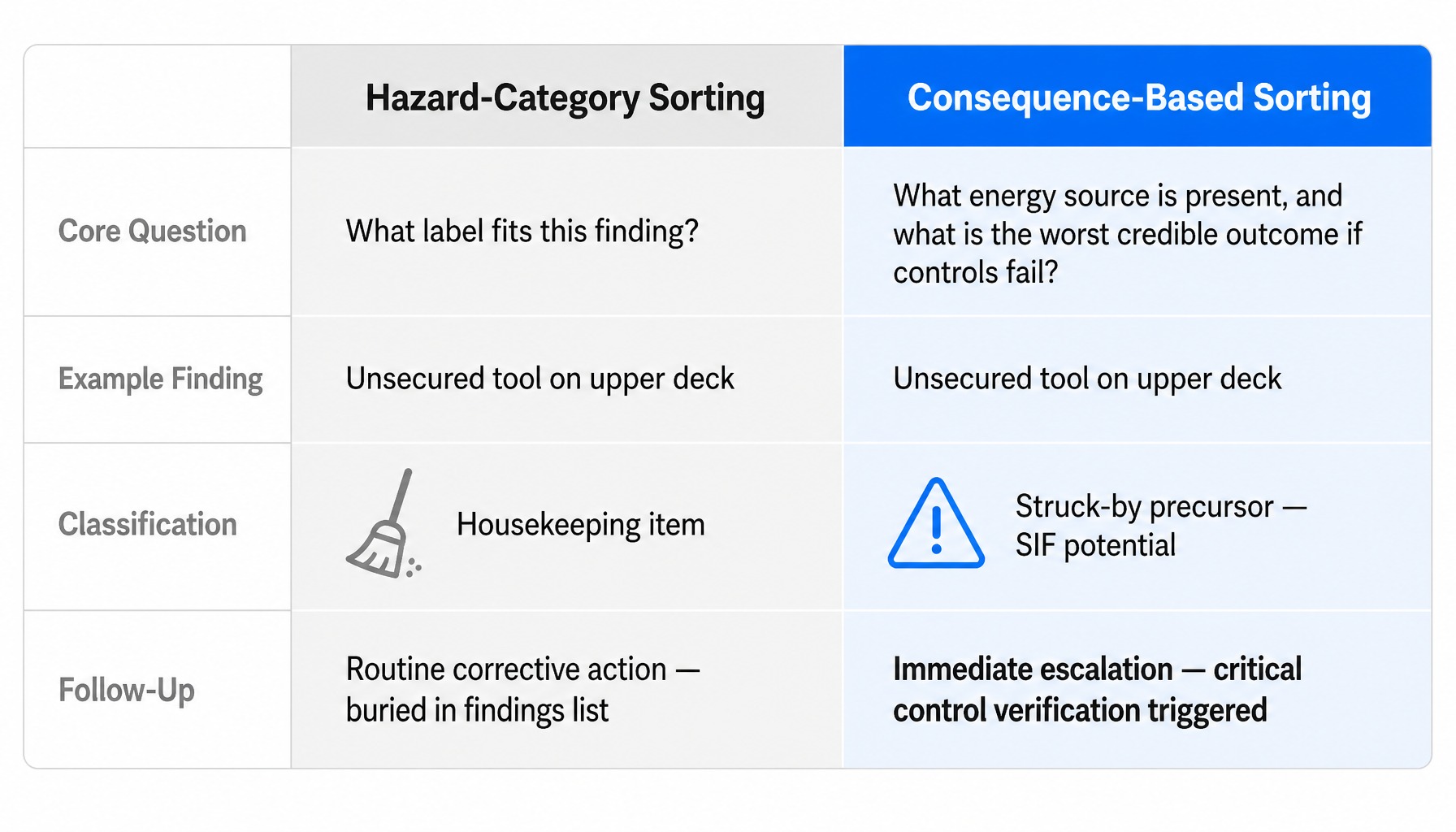
The practical difference is in the question you ask at the point of data capture.
- Hazard-category sorting asks: What label fits this finding? (e.g., PPE, housekeeping, scaffolding).
- Consequence-based sorting asks: What energy source is present, and what is the worst credible outcome if controls fail?
An unsecured tool on an upper deck illustrates this. Under hazard-category sorting, it’s a housekeeping item. Under consequence-based sorting, it’s a struck-by precursor with SIF potential for anyone working below. The sorting method determines whether the high-potential item surfaces for immediate action or gets buried in a list of routine findings. The unsecured tool is a SIF-capable condition: a hazard where the energy and exposure could credibly produce a fatality.
Read more: How Data Helps Improve Hazard Identification
How Trade Stacking Multiplies SIF-Capable Conditions
On complex, multi-contractor sites, single-trade observations often miss SIF-capable conditions created by the interaction of different crews. Trade stacking, where multiple subcontractors work in the same zones at once, creates compound energy exposures that no single trade’s pre-task plan anticipated. This is especially true on projects like data-center construction, where compressed schedules force concurrent work.
For example, an electrical crew may be working on overhead rough-in while a mechanical crew uses a scissor lift below them. This introduces both energized conductors and the potential for a caught-in incident into a space where neither crew’s Job Hazard Analysis fully accounted for the other’s exposure profile. Identifying these compound risks requires a cross-trade view during daily planning, which is also where subcontractor coordination tends to break down.
Why High Observation Counts Can Miss High-Potential Exposures
Observation quotas reward easy, low-severity findings, so a high count can hide the few high-energy exposures that actually come before a SIF.
Observation programs measured by volume reward quantity over quality. A superintendent with a quota of five observations a week will often log the easiest items, like “no PPE” or “trash on floor,” because they’re quick to spot and record. The result is a database full of low-severity findings that creates a false sense of hazard visibility. This is the “green-on-green” problem: a dashboard full of positive activity that masks a growing SIF exposure.
Observation programs that reward volume over quality create a data environment where safety directors can’t distinguish between a housekeeping note and a life-threatening energy exposure. The resulting blind spot tends to persist until a SIF or near-fatal event forces a review of months of low-value submissions. Categorizing each observation by severity as it’s submitted helps close that gap.
Three signs suggest an observation program is generating volume without capturing SIF precursors:
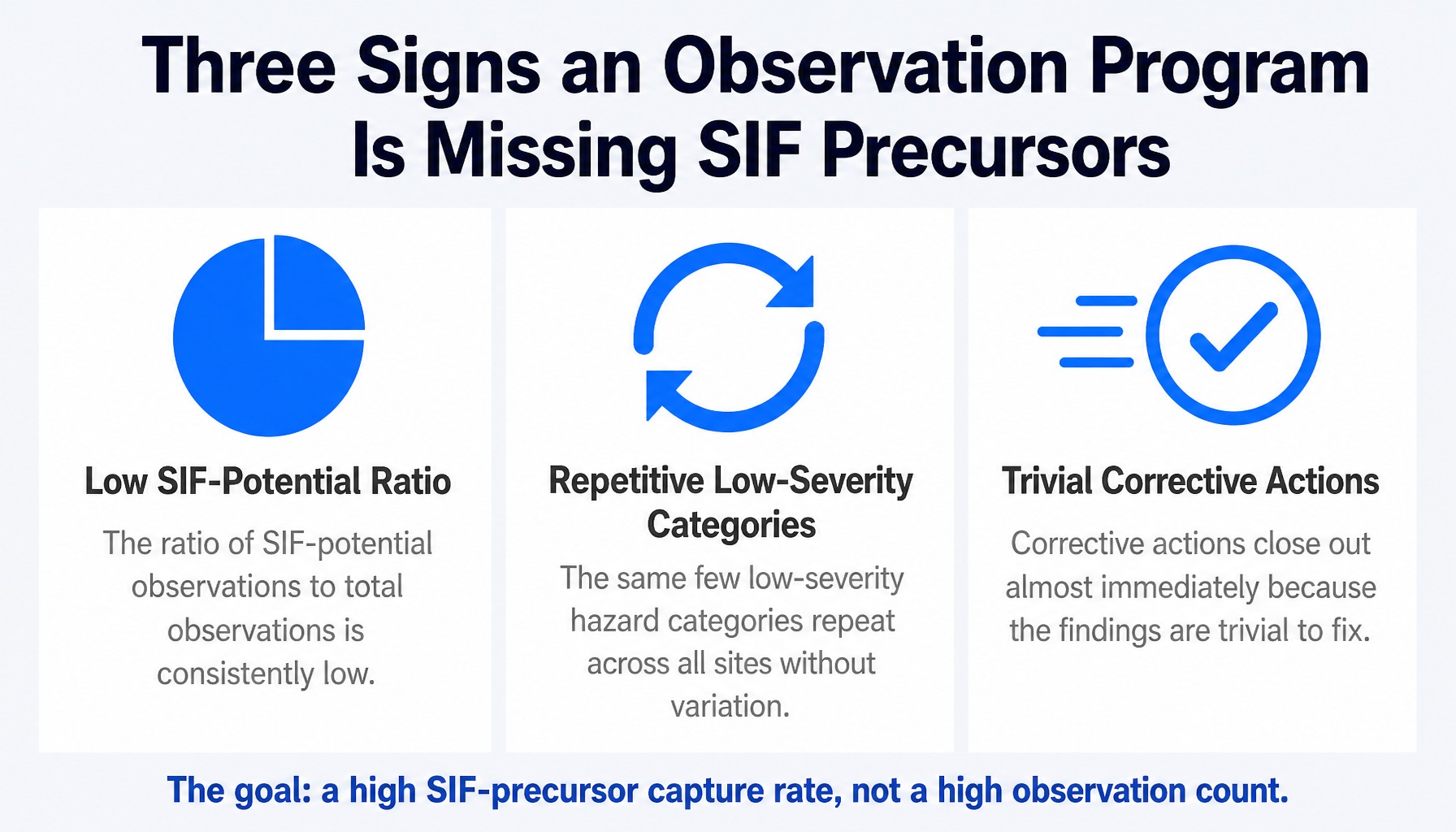
- The ratio of SIF-potential observations to total observations is consistently low.
- The same few low-severity hazard categories repeat across all sites without variation.
- Corrective actions close out almost immediately because the findings are trivial to fix.
A better measure is the SIF-precursor capture rate, which tracks the share of observations that flag a high-energy exposure.
Permit-to-Work Breakdowns as Unrecognized SIF Precursors
A permit-to-work breakdown happens when high-energy work starts without confirmed controls, often because site conditions changed after approval.
Permit-to-work systems are designed to be a final verification that critical controls are in place before high-energy work begins. When these systems break down, they create unrecognized SIF precursors. The energy is present, but the controls are not confirmed. This is especially common on sites with heavy trade stacking, where one crew’s hot-work permit may not account for another crew’s combustible materials stored in the adjacent bay.
On a large industrial project, a hot-work permit might be issued for welding on Level 3. Between permit issuance and the start of work, a coatings crew moves solvent containers into the adjacent space for an afternoon scope. The permit’s fire-watch zone no longer reflects the actual exposure.
OSHA’s fire prevention rule for welding and cutting, 29 CFR 1926.352, requires moving or protecting nearby fire hazards before hot work. A scope change after the permit is issued can quietly break that control. If the permit data were captured digitally and time-stamped, the gap between permit issuance time and the scope change would become visible.
How Learning Teams Surface SIF Precursors That Investigations Miss
A learning team reviews an event to understand the conditions that allowed it, which surfaces system gaps a root-cause investigation can miss.
Traditional incident investigations and learning teams serve fundamentally different purposes. An investigation usually narrows its focus to a single root cause, often human error or a procedural violation, so the file can be closed. A learning team, in contrast, widens its focus to ask what conditions and system gaps allowed the exposure to exist and persist. Learning teams are a component of Human and Organizational Performance (HOP), an approach that studies how work actually gets done in the field. This approach surfaces issues like barrier decay, normalization of deviance, and misaligned incentives that a blame-focused investigation filters out.
A near miss involving a caught-in exposure at a conveyor system is a good example.
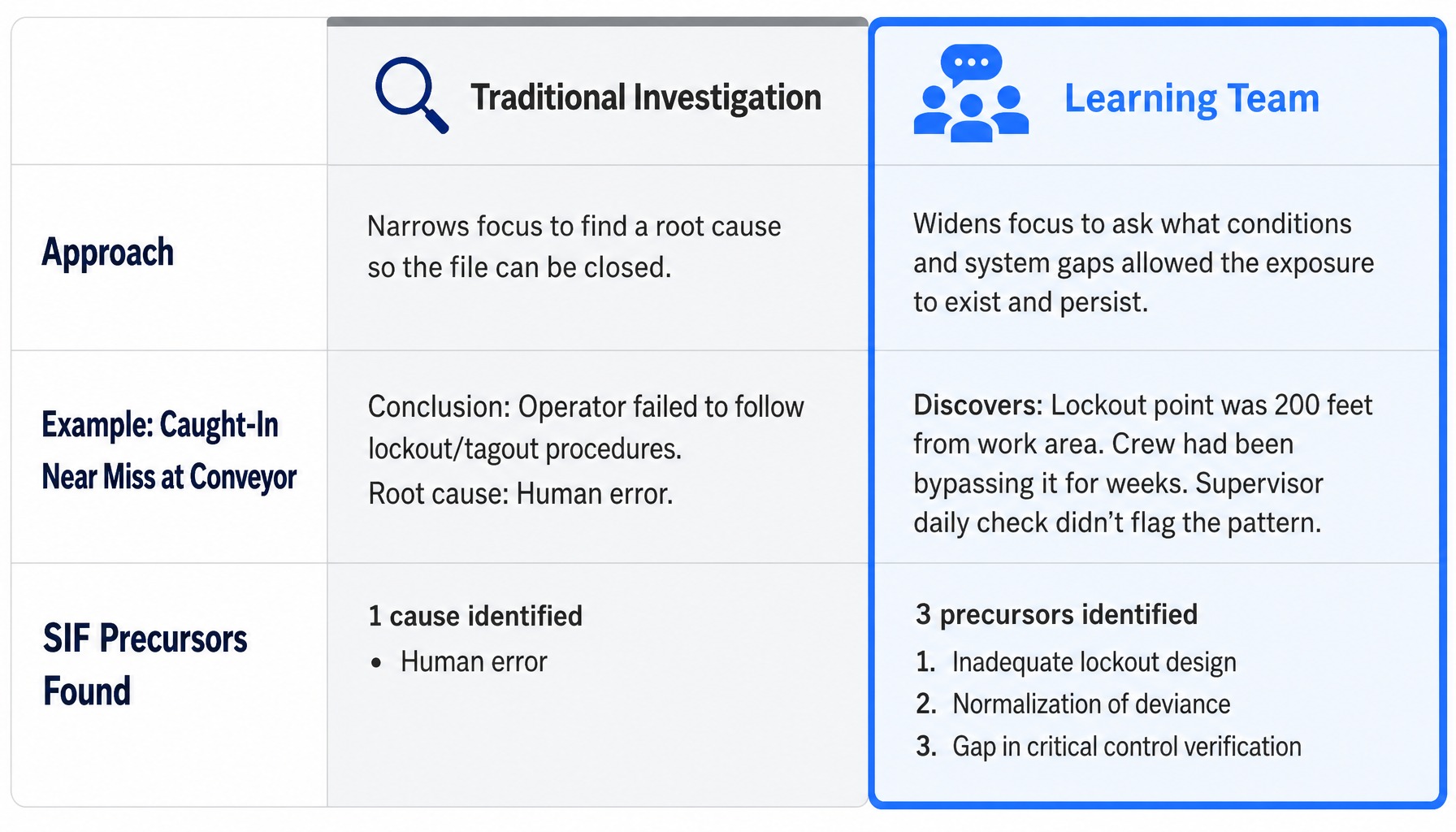
- The Investigation: Concludes the operator failed to follow lockout/tagout procedures. The root cause is “human error.”
- The Learning Team: Asks why the operator bypassed the procedure. It discovers the lockout point was 200 feet from the work area, the crew had been bypassing it for weeks, and the supervisor’s daily check didn’t flag the pattern.
The investigation finds one cause. The learning team surfaces three SIF precursors: inadequate lockout design, normalization of deviance, and a gap in critical control verification. When a learning team identifies systemic gaps, the findings should feed into a corrective action plan that tracks barrier restoration to completion.
Connecting Frontline Data to SIF Precursor Visibility
SIF precursor visibility means high-potential items from daily field data reach the right leaders before they turn into a serious injury.
SIF precursors hide in plain sight because the data systems most organizations rely on, from TRIR to paper permits, filter out consequence potential.
- For the safety director reviewing morning reports, this means seeing the three struck-by precursors from yesterday’s steel erection scope at the top of the list, above 40 housekeeping findings. Safety Mojo’s Risk Feed reviews pre-task plans, observations, near misses, and incident reports as crews submit them. It ranks the top items by priority and explains why each one was flagged.
- For the superintendent planning the day’s high-risk work, this means knowing which crews have permit-required tasks on the schedule. Flex PTP flags high-risk work in each crew’s pre-task plan and notifies supervisors of permit requests included in those plans, so those tasks get reviewed before work starts.
- For field leaders deciding where to spend time on site, this means seeing the day’s highest-risk work in one place. The My Day Dashboard pulls a project’s safety forms onto one screen and highlights high-risk work like crane lifts, trenching, and hot work.
Request a demo to see how Safety Mojo connects frontline data to SIF precursor visibility.
Frequently Asked Questions
How should safety teams classify a near miss as a SIF-potential event?
Apply a consequence-based filter. Ask whether the energy source present (gravity, electrical, kinetic, etc.) could have produced a fatality or life-altering injury if the exposure had been slightly different. If the answer is yes, classify it as a PSIF regardless of the actual outcome. This classification should trigger a different follow-up pathway, including critical control verification and leadership review.
What frontline data should safety teams watch for SIF risk?
Watch for repeated gaps in life-critical controls like fall protection, energy isolation, and rigging, especially in high-energy work zones with long exposure hours. Permit-to-work problems and a shrinking share of SIF-potential observations are also worth tracking, since both can mean high-energy exposures are going unrecorded.
How do critical controls differ from general safe work practices in SIF prevention?
General safe work practices, like wearing PPE, reduce injury frequency across all severity levels. Critical controls are the specific barriers that prevent a high-energy hazard from reaching a worker and causing a fatality. Examples include fall-arrest anchorage integrity, lockout/tagout verification, and crane exclusion zones. SIF prevention focuses verification on critical controls because their failure is what converts an exposure into a catastrophe.
What role does trade stacking play in SIF exposure on multi-contractor sites?
Trade stacking creates compound energy exposures that no single crew’s pre-task plan anticipated. When multiple trades occupy the same zone, the interaction of their energy sources, such as gravity from overhead work and electricity from rough-in, can produce SIF-capable conditions. Effective SIF precursor programs require cross-trade visibility during daily planning, not just trade-by-trade hazard reviews.
What does a SIF precursor tracking program look like for a general contractor?
A GC-level program classifies every observation and near miss by consequence and sends SIF-flagged items through a separate escalation path. A dashboard surfaces SIF-potential findings to leadership daily. The program tracks the SIF-precursor capture rate as a leading indicator, reported alongside TRIR and other lagging metrics. It focuses verification on critical controls tied to high-energy scopes.
What is a SIF-capable condition and how is it different from a standard hazard?
A SIF-capable condition is a hazard where the energy source and exposure could produce a fatality or life-altering injury if controls fail. A standard hazard, like a tripping hazard at grade, can cause injury but lacks the energy to produce a SIF. The distinction is critical because SIF-capable conditions require immediate escalation and critical control verification, while standard hazards follow routine corrective-action timelines.


