

Key Takeaways
- Subcontractor prequalification covers the paperwork, while safety management tends to break down in the gap between that paperwork and daily field execution.
- Job hazard analyses drift on long-duration projects. Let changing site conditions trigger re-evaluation.
- High observation counts from a subcontractor can mask declining hazard visibility if the program is quota-driven and focused on low-severity items like personal protective equipment.
- Track serious injury and fatality precursors separately from the total recordable incident rate, because a low recordable rate can hide significant high-potential exposure.
- Permit-to-work systems often fail under trade stacking when supervisors issue overlapping permits for the same area without separating the work in space.
Many general contractor safety programs invest heavily in subcontractor prequalification. Safety teams scrutinize experience modification rates, run firms through ISNetworld or Avetta, verify insurance, and review written safety programs. Once the safety team approves a subcontractor, it can feel like the hard work is done. In practice, learning how to manage subcontractors matters most after that approval, when daily field work tests whether the safety plan holds.
A subcontractor can pass every prequalification gate and still arrive on site with a crew using a stale job hazard analysis, a competent person designation that exists only on paper, and an observation program that generates volume without surfacing real hazards. The breakdowns that lead to serious incidents tend to happen in this space between corporate approval and crew-level work. These failures quietly accumulate exposure until an event makes them visible, and the controlling employer can end up answering for them under the Occupational Safety and Health Administration’s multi-employer citation policy.
The five breakdowns below are where that exposure builds up unnoticed, and prequalification wasn’t built to catch any of them.
Why Bridging Documents Break Down Between General Contractor and Subcontractor Safety Programs
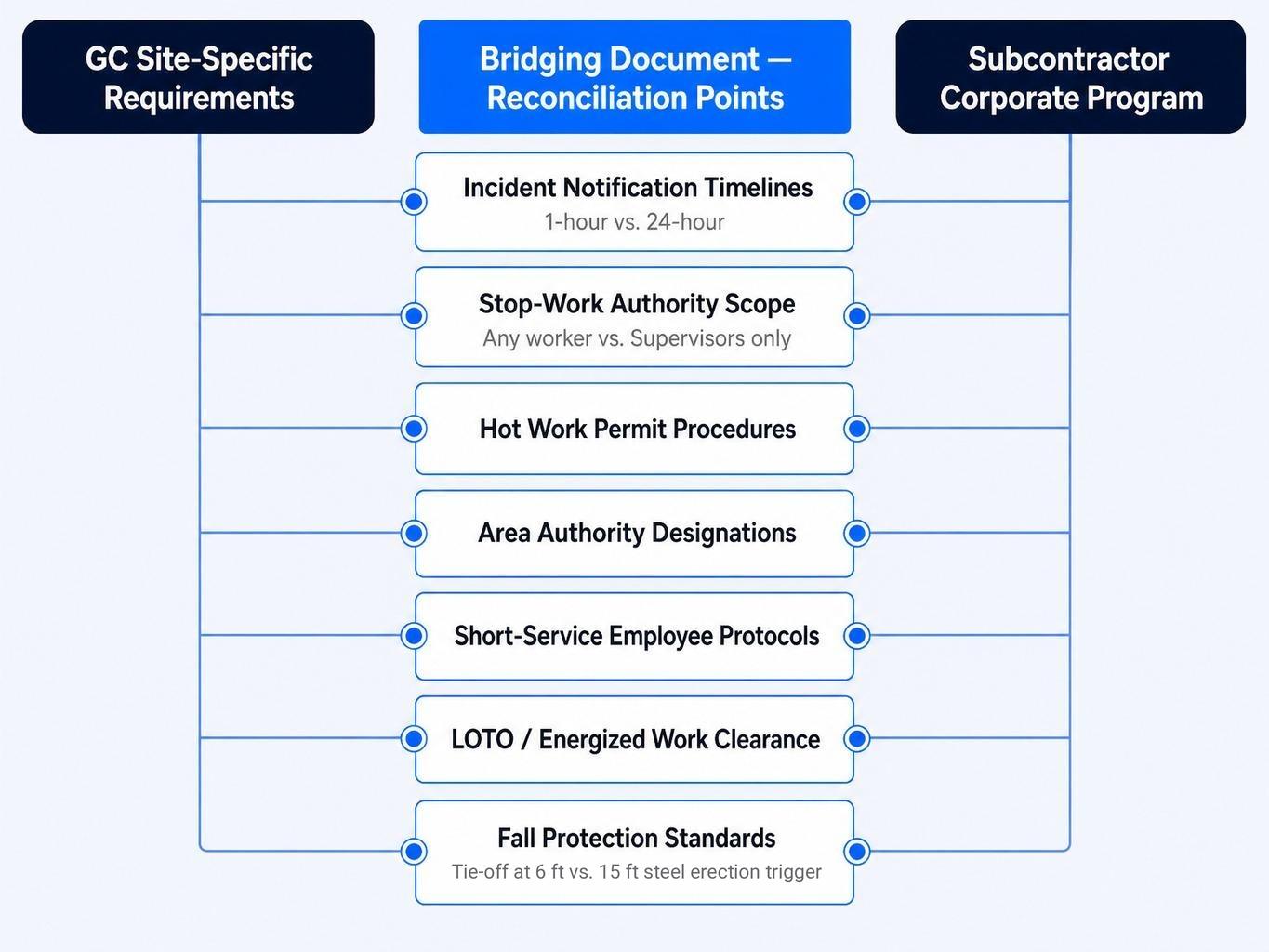
A bridging document reconciles a subcontractor’s safety program with the general contractor’s site rules before the crew starts work.
Many general contractors review a subcontractor’s written safety program during prequalification, approve it, and file it away, which skips the step of reconciling the two programs. A steel erection subcontractor’s fall protection plan may follow OSHA’s 15-foot trigger for steel erection, while the general contractor requires 100% tie-off at six feet across the site. Without a bridging document to identify and close that gap, the crew defaults to its own company’s standard and creates unrecognized risk on the general contractor’s site.
These gaps show up in everyday procedures, too. A subcontractor’s program might specify a 24-hour incident notification timeline, while the general contractor and owner require notification within one hour, and its hot work permit procedure might differ from the site’s. Misalignments like these come from two compliant but different safety systems that no one connected, and that’s where operational control gets lost.
The bridging document forces a deliberate conversation about standards before mobilization, well ahead of any near miss. Settling these differences early follows the same logic as Prevention through Design, outlined in ANSI/ASSP Z590.3, which addresses hazards during design and planning, before work begins.
Identifying the Gaps a Bridging Document Must Reconcile
Many bridging failures sit in operational details more than in major program areas like fall protection. These are the places where a subcontractor’s corporate program and the general contractor’s site-specific rules diverge without anyone noticing until an event forces the question. Critical areas for reconciliation include incident notification timelines and near-miss reporting thresholds, which often differ significantly.
Stop-work authority is another frequent point of friction. A general contractor’s policy may empower any worker to stop work, while a subcontractor’s program might restrict that authority to supervisors.
Other key areas include hot work permit requirements, area authority designations for work zones, and protocols for short-service employees, like green-hat programs. The two programs also need to align on how crews coordinate lockout/tagout for energized work clearances. Without explicit reconciliation, crews tend to follow the program they know.
Connecting Bridging Requirements to Daily Pre-Task Planning
A bridging document does little good if it sits in a project control binder and never reaches the crew. The reconciled requirements, especially those covering permit-to-work, lockout/tagout, and competent person designations, need to flow directly into daily activity briefings and Pre-Task Plans.
The project safety manager and the subcontractor’s safety representative may spend hours on a detailed bridging document while the foreman running the 6 a.m. Pre-Task Plan meeting has never seen it.
That foreman defaults to the company’s standard JHA or Pre-Task Planning template, and the site-specific requirements never reach the crew. For the document to have operational value, its key controls have to show up in the daily planning tools the crew actually uses. If a site requires a specific type of anchorage for fall protection, that requirement needs to appear on the JHA the crew fills out for that task, making the site-specific rule part of the daily plan.
How Job Hazard Analyses Drift on Long-Duration Projects
Job hazard analysis drift happens when a job hazard analysis stays the same while trades, equipment, and site conditions change around it.
Teams often put more effort into a JHA’s first draft than into re-evaluating it. An excellent JHA written during mobilization for a 14-month industrial project may describe conditions that no longer exist by month four. Adjacent trades have changed, equipment layouts have shifted, and concurrent operations have introduced new line-of-fire exposures.
On a hyperscale data-center build, the scope of concurrent operations can change weekly as different trades mobilize and demobilize. A JHA for work in a riser shaft written before mechanical, electrical, and fire protection crews were present misses the primary hazards of trade stacking. A job hazard analysis that doesn’t adapt to those changes leaves crews without controls for the hazards they now face. Effective subcontractor JHA management comes down to a reliable way of deciding when each JHA needs another look.
A Trigger-Based Re-Evaluation Model for Subcontractor JHAs
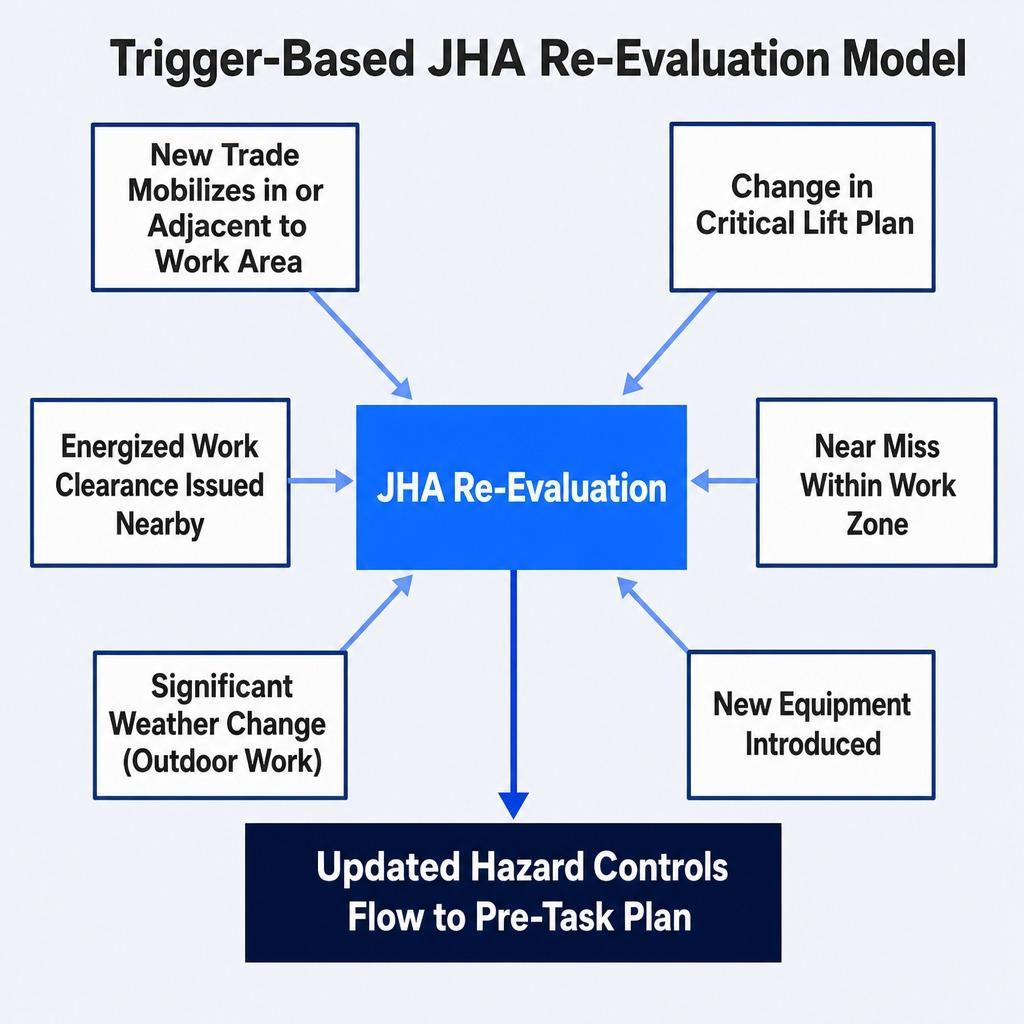
Calendar-based JHA reviews, like monthly or quarterly checks, are often disconnected from field operations. A trigger-based model works better, with re-evaluation prompted by specific changes in the work environment. Crews then reassess hazards in response to actual changes on site.
Key triggers include a new trade mobilizing in or next to the work area, a change in a critical lift plan, an energized work clearance issued nearby, or a near miss in the work zone. A change in weather for outdoor work or the introduction of new equipment should also prompt an immediate review. This approach ties the JHA directly to conditions on the jobsite, catches hazard recognition gaps that time-based reviews miss, and keeps the analysis current.
When High Observation Counts Mask Declining Hazard Visibility
A high observation count can hide a program that records mostly easy, low-severity items while missing the hazards that matter most.
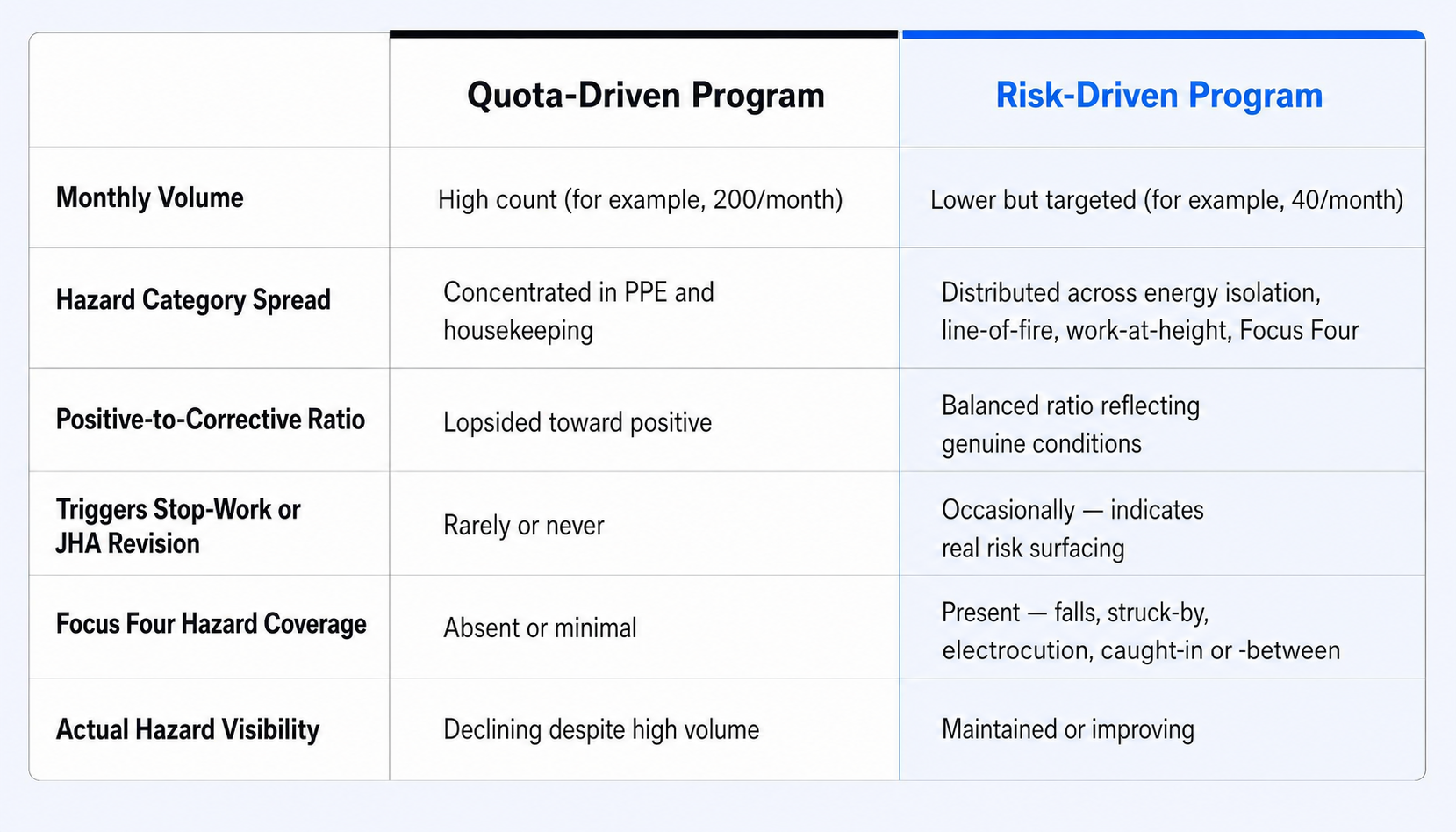
A subcontractor submitting 200 observations a month can be generating less hazard visibility than one submitting 40. The difference comes down to whether the program is quota-driven or risk-driven. For example, a subcontractor’s observation program might post high monthly counts that look strong in a dashboard summary, while a closer read shows most submissions describe personal protective equipment compliance or housekeeping.
Almost none capture energy isolation gaps, line-of-fire exposures, or work-at-height deviations. Crews in a quota-driven program learn early that PPE observations are fast to write and rarely draw follow-up questions. The high count ends up masking a decline in the program’s ability to surface the exposures most likely to produce a serious injury.
Safety directors can gauge the quality of a subcontractor’s observation program with a few indicators. One is the ratio of positive to corrective observations, since a lopsided positive share can signal crews are gaming the metric. Another is the same few hazard categories repeating week after week.
Most telling is the absence of observations related to OSHA’s Focus Four hazards: falls, struck-by, electrocution, and caught-in or -between. A healthy program will occasionally trigger a stop-work action or a JHA revision, and a program that never does is likely missing significant risk.
Scoring the quality of each plan adds another check. See how Pre-Task Plan quality scores signal jobsite risk.
Tracking Serious Injury and Fatality Precursors Separately from Recordable Rates
Serious injury and fatality precursors are high-risk exposures that could have killed someone, and they need tracking apart from recordable rates.
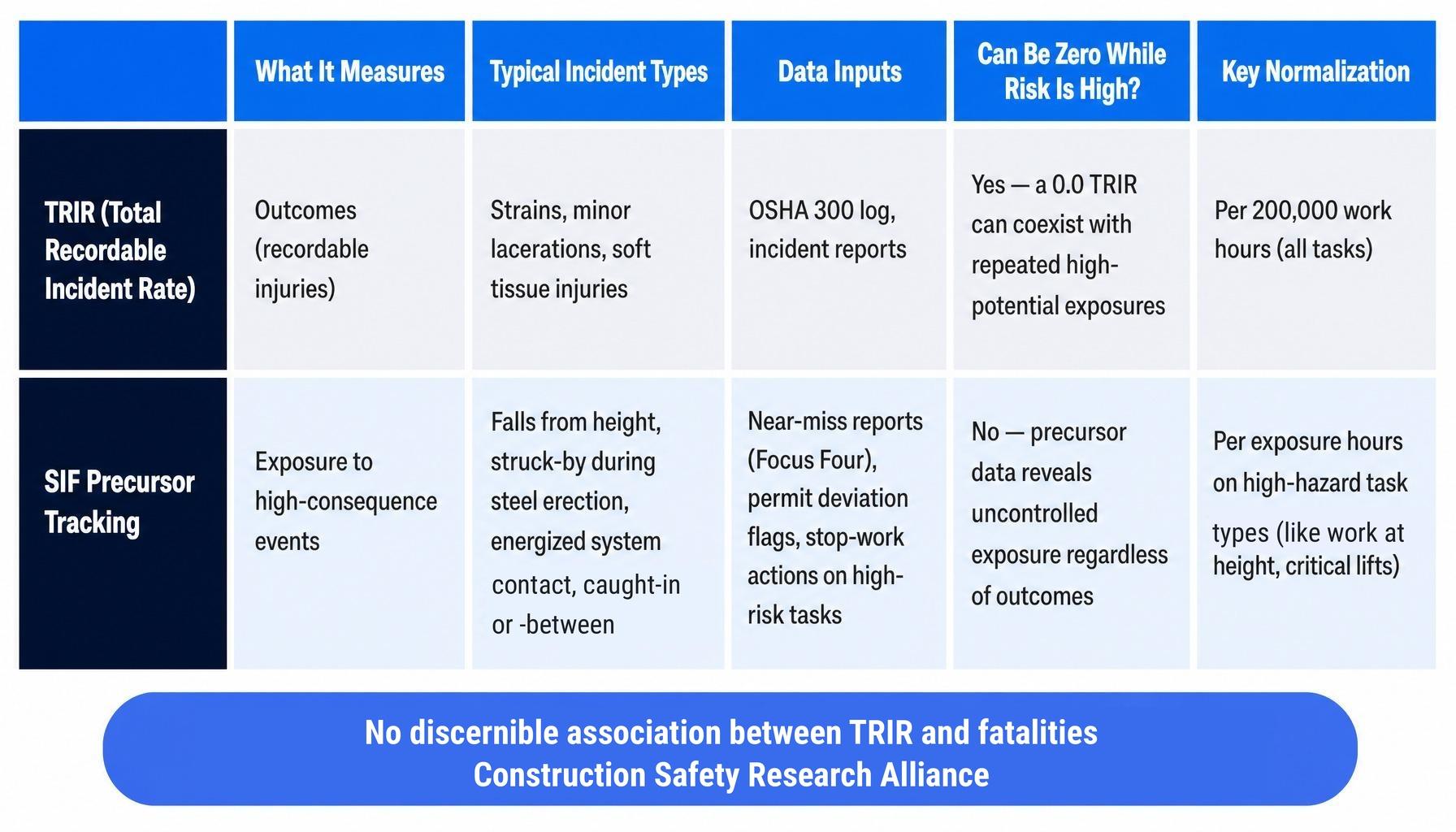
A subcontractor’s total recordable incident rate can be at or near zero while its crews are routinely exposed to these precursors, which the Campbell Institute describes as high-risk situations where controls are broken, absent, or not complied with. Recordable rates measure injury outcomes, while precursor tracking measures exposure to high-consequence events that, under slightly different circumstances, could have been fatal or life-altering.
A subcontractor with a 0.0 recordable rate on a 12-month project might have field observations repeatedly flagging uncontrolled struck-by exposure during steel erection. None of those events produced a recordable, but the exposure severity was high. Judging subcontractors mainly on recordable rates leaves that exposure out of the picture.
Precursors and recordable incidents often involve different causal mechanisms. The Construction Safety Research Alliance, analyzing more than 3.2 trillion worker-hours of member data, found no discernible association between total recordable incident rates and fatalities. Precursor tracking therefore has to be a separate, deliberate data stream focused on high-potential exposures, like working at height without redundant tie-off, working near energized systems, or performing critical lifts.
Building a Separate Data Stream for Precursors
Precursor tracking needs different inputs than recordable rates. The key inputs are near-miss reports involving the Focus Four hazard categories, observations that flag uncontrolled energy sources or permit deviations, and stop-work actions related to high-risk activities. This data often sits in frontline reports, but standard safety dashboards tend to roll everything into a single incident rate.
A critical part of the analysis is normalizing exposure hours against high-hazard task types. One subcontractor with 1,000 hours of work at height has a different risk profile than one with 1,000 hours of ground-level finish work, even if both have zero recordables. Exposure-normalized data shows where the potential for a serious event concentrates.
Safety Mojo’s Contractor Scorecard gives each subcontractor a current safety score built from leading and lagging indicators.
Where Permit-to-Work Systems Fail Under Trade Stacking
Trade stacking puts several subcontractors in one space during one shift, which strains permit systems built for one trade at a time.
On large industrial projects and hyperscale data-center builds, trade stacking is often a daily condition. Permit systems fail when supervisors issue hot work permits, energized work clearances, and confined space entries independently, without cross-referencing other active permits in the same location. Beyond the safety exposure, those failures can create regulatory liability for the controlling contractor.
A hot work permit issued to an ironworker crew in a mechanical room can directly conflict with an energized work clearance held by an electrical subcontractor in the same space. Neither crew’s Pre-Task Plan may reflect the other’s presence or hazards. Fixing that coordination failure means connecting permit data to daily Pre-Task Planning.
Before any crew begins work, the area authority needs a consolidated view of all active permits in a given zone, so they can separate conflicting work in space and time. Without that visibility, the permit system creates a false sense of security while conflicting high-risk tasks proceed in parallel.
Closing the Gap Between Field Data and Subcontractor Oversight with Safety Mojo
Subcontractor management fails when the data needed to catch bridging gaps, JHA drift, and permit conflicts is trapped in paper forms or delayed reports. Safety Mojo makes that frontline data usable without asking every subcontractor to change how its crews plan the work.
- Flex PTP reads each subcontractor’s own paper, whiteboard, or PDF Pre-Task Plans and JHAs from a photo and scores them for the quality of their task steps, hazards, controls, and PPE. Permit requests included in a plan can trigger notifications and approval workflows. Because the site can personalize the scoring rubric to its safety program, the general contractor can check whether site-specific requirements show up in crews’ daily plans without forcing every subcontractor onto the same form.
- My Day Dashboard shows Pre-Task Plans, permits, observations, and open corrective actions by site in one view, flags high-risk work as plans come in, and highlights permits awaiting review. An area authority can see crews’ high-risk work and permits awaiting review in one place.
- Risk Feed ranks the highest-priority items from the Pre-Task Plans, observations, near misses, and incident reports every subcontractor submits, with the reasoning behind each flag and a suggested next step. Safety directors can follow up on high-potential exposures across projects instead of waiting for a recordable to show where the risk sits.
These capabilities help close the gap between the prequalification file and what crews actually do in the field. See how Safety Mojo connects frontline data to subcontractor oversight.
Frequently Asked Questions
How do learning teams work across subcontractor boundaries after a near miss?
A learning team after a near miss on a multi-subcontractor site should include representatives from every trade working in or next to the affected area, along with the subcontractor involved. The general contractor’s safety team facilitates, and the goal is a shared understanding of contributing conditions with blame kept out of the room. Document the lessons and share them across the project portfolio.
How can general contractors verify subcontractor competent person designations on site?
Verification goes beyond checking a name on a form. The general contractor should confirm during orientation that the designated person can explain the specific hazards for their scope, has the authority to stop work, and is physically present during the work. Spot-checks during field walks are one of the more reliable ways to confirm it.
What should a subcontractor prequalification process evaluate beyond experience modification rate and insurance?
Beyond experience modification rate and insurance, prequalification should assess a subcontractor’s near-miss reporting history, how it tracks serious injury and fatality precursors, the quality of its written JHAs for comparable scopes, and whether it has a documented bridging process. A subcontractor that can’t produce recent near-miss data may have a reporting culture problem regardless of its recordable rate.
How does frontline hazard data from subcontractors feed into a general contractor’s daily planning?
Review observations, near-miss reports, and open corrective actions from the previous shift during the daily activity briefing. The general contractor’s planning process should filter this data by work zone so the area authority sees hazard trends for the areas where crews will be active that day, turning the data into a planning input.
How do data-center and hyperscale projects create unique subcontractor management challenges?
Hyperscale builds compress timelines, stack more trades into tighter spaces, and cycle subcontractors in and out faster than traditional projects. That pace accelerates JHA drift, increases permit conflicts, and makes bridging document alignment harder to maintain. Safety programs designed for stable crew compositions tend to struggle to keep up.


