

Key Takeaways
- Pencil whipping is a data-quality failure driven by process friction and misaligned metrics, and it hides the exposures most likely to cause serious injuries and fatalities.
- The two main drivers are checklist fatigue, where the volume of paperwork makes copying feel like a rational choice for crews, and quota-driven observation programs that reward “ghost observations” submitted to meet a number.
- Pencil whipping leaves detectable patterns in safety data: timestamp clustering, identical language across different trades and days, observation counts that spike at the end of a reporting period, and a lack of photos or location-specific details.
- Learning teams help uncover the root causes, like form design, scheduling conflicts, or bad metrics, that make pencil whipping the path of least resistance.
- The lasting fix is removing friction at the point of work, so capturing real conditions takes less effort than filling in a form from memory.
A safety director for a general contractor building a large data-center campus might pull a week of Pre-Task Plans from several subcontractors. In that stack, 14 of the 18 job hazard analyses could list identical hazards, identical controls, and identical crew signatures across three trades working in separate areas of the building. The paperwork might be complete, signed, and filed, but the data could be low quality and useless.
That is pencil whipping: filling out a safety document to satisfy a requirement without performing the underlying work, inspection, or verification. On complex construction and industrial projects, it can quietly undercut an entire safety program.
The cause is usually systemic: process friction, misaligned metrics, and documentation demands that are out of sync with the pace of field operations. The shortcut also conceals the very exposures and serious injury and fatality precursors that safety programs exist to catch.
Let’s dive in and talk about why crews pencil whip, the data patterns that give it away, and how to prevent it.
What Pencil Whipping Actually Means on a Jobsite
Pencil whipping means completing, signing, or approving a safety document without doing the inspection or verification it describes.
It shows up on inspection forms, Pre-Task Plans, permits, and observation cards, and digital tools haven’t made it go away.
Intentional falsification does happen, but most pencil whipping comes from a crew member or supervisor filling in expected answers from memory or assumption because the process rewards completion over accuracy. A foreman who has walked the same laydown yard for 50 straight mornings may truly believe he knows the hazards and fill out the form in his truck. He’s taking a shortcut that feels rational to him, with no intent to deceive.
On construction and industrial sites, the documents most vulnerable to pencil whipping include:
- Daily equipment or area inspection checklists
- Job hazard analyses or Pre-Task Plans
- Behavior-based safety observation cards
- Permit-to-work forms, like hot work or confined space entry
Practitioners have other names for it, including rubber stamping, box checking, ghost observations, and desk-signed permits. Whatever the name, the result is safety data that shows compliance on paper and tells leaders nothing about conditions in the field.
When it is intentional, the legal exposure is real. Knowingly falsifying a required record can bring criminal penalties under Section 17(g) of the Occupational Safety and Health Act, and false injury and illness logs can draw citations under the Occupational Safety and Health Administration’s recordkeeping rule.
Why Crews Pencil Whip and Why Blaming Them Misses the Point
When a safety leader discovers pencil whipping, the first reaction is usually frustration directed at the person who signed the form. In most cases, though, it’s a symptom of how leaders design the system, and crews are responding to the incentives leadership has created.
The behavior becomes ingrained over time through what sociologist Diane Vaughan, in her study of the Challenger disaster, called the normalization of deviance. When a crew takes a shortcut and nothing bad happens, the deviation from the formal process slowly becomes the informal, accepted standard of work. To stop it, look past the person holding the pen and at the system that made faking the paperwork the easiest option.
Checklist Fatigue and the Friction Problem
Before an excavation crew starts digging, the foreman may owe a Pre-Task Plan, a daily excavation inspection, a mobile equipment checklist, an observation card, and a hot work permit review. When that stack repeats the same questions every morning, checklist fatigue sets in, and crews stop giving each form real attention.
Under production pressure, crews start filling out the most repetitive forms from memory, and copying yesterday’s answers becomes routine.
Cutting redundant paperwork helps, and digital forms can make that easier. Check out the top 4 benefits of switching from paper forms to construction safety management software.
Quota-Driven Observation Programs and Observation Stuffing
Many safety programs revolve around volume targets, like requiring each supervisor to submit five observation cards per week. Quota cards create a direct and powerful incentive to pencil whip. When the main measure of success is a count, frontline leaders will tend to optimize for the count.
Supervisors and crew members may submit ghost observations or copy previous entries at the end of the week to hit their numbers. This observation count inflation pollutes the data the whole observation program depends on. On paper, the program looks healthy and engaged while actual hazard visibility declines.
Frontline Data Patterns That Expose Pencil Whipping
Safety leaders who know what to look for can spot pencil whipping in submission data without witnessing it firsthand on every site. The patterns show up in form metadata as well as in the content of the forms themselves.
- Timestamp Clustering: This is usually the most obvious signal. A supervisor who submits five equipment inspections and three JHAs within a six-minute window at 6:05 AM is most likely completing them in a batch from a truck or trailer, with no time for sequential verification in the field.
- Identical Language: In the data-center example above, JHAs from an electrical crew and a concrete crew could use the exact same phrases to describe hazards and controls, despite working on different floors with entirely different scopes. That copy-paste pattern is very unlikely to come from real field-level hazard analysis.
- End-of-Period Spikes: When you graph observation data over time, a quota-driven program tends to show spikes in submission volume on the last day of the reporting period, like Friday afternoon. Those spikes reflect supervisors stuffing observations to meet their weekly number. In a healthy program, the ratio of observations to project exposure hours tends to stay relatively stable.
- Absence of Specificity: A real field observation includes context, like “Crew member near unprotected edge on Level 3, west side.” A pencil-whipped entry tends to be generic, like “Worker not tied off.” Missing photos, location details, or names of the people involved strongly suggest someone wrote the report at a desk.
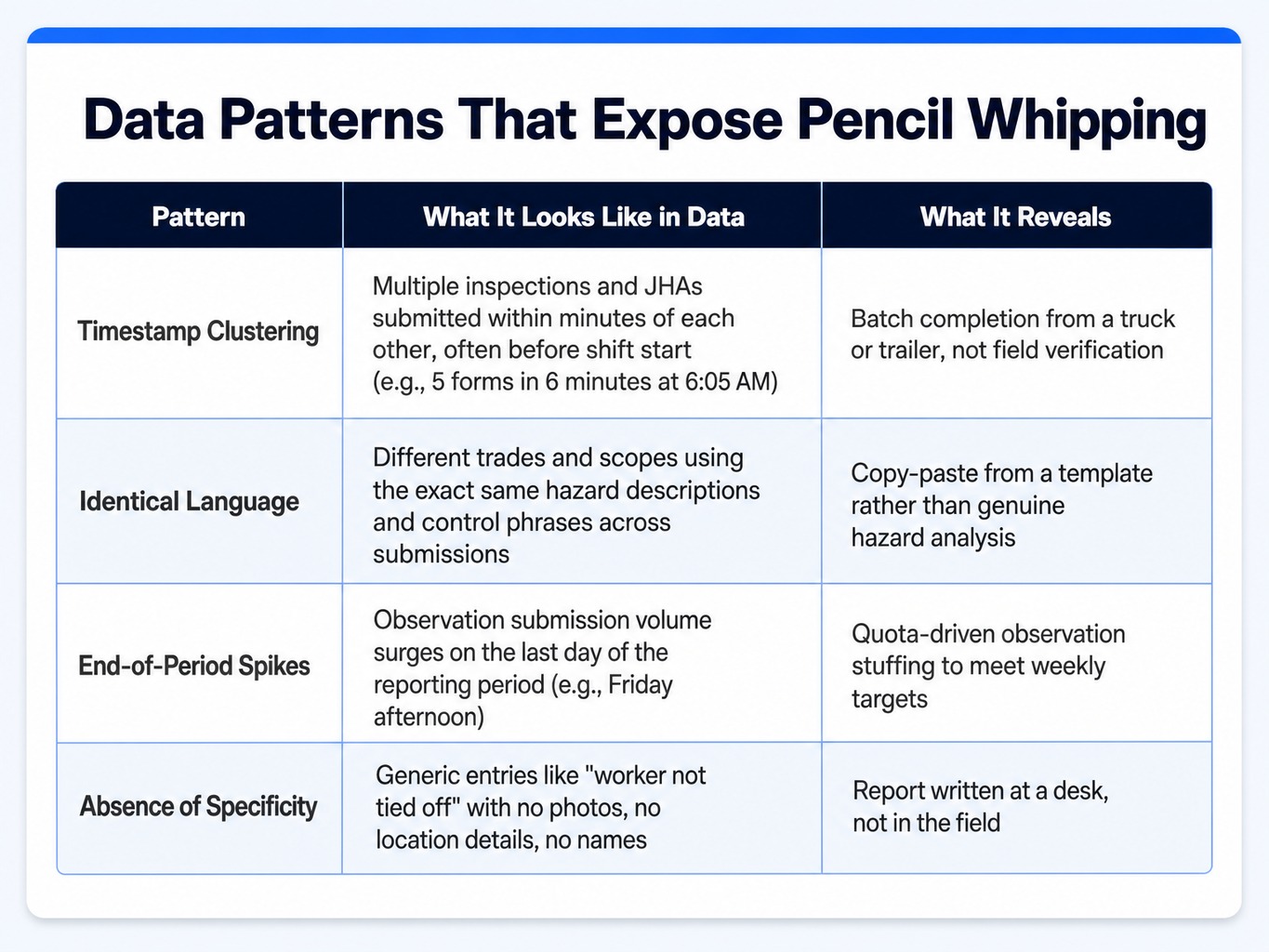
Scoring each Pre-Task Plan for specificity catches the content side of these patterns. For more info, see how Pre-Task Plan quality scores signal jobsite risk.
How Pencil Whipping Masks Serious Injury and Fatality Precursors
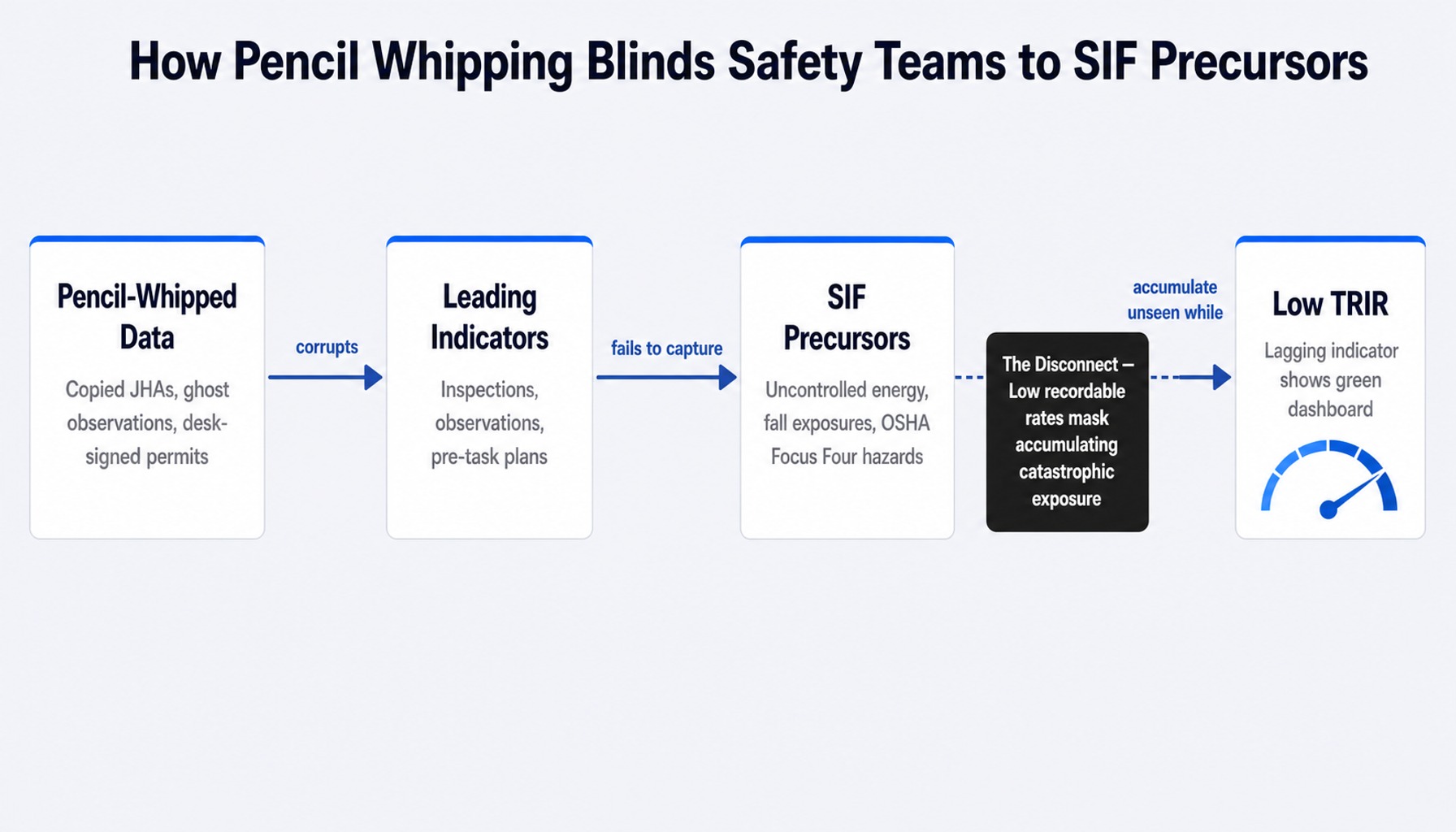
Pencil whipping hides the conditions most likely to cause a death or life-altering injury, because the forms meant to catch them stop recording them.
A project can maintain a low total recordable incident rate for months while pencil-whipped inspections and observations fail to capture serious injury and fatality precursors. The Campbell Institute describes these precursors as high-risk situations where controls are broken, absent, or not complied with, like working at height without fall protection. Unprotected edges and uncontrolled energy fit that definition too, and both tie back to OSHA’s Focus Four hazards. Safety data only shows these precursors when it captures specific, high-risk conditions instead of generic checkbox answers.
A pencil-whipped Pre-Task Plan that lists “fall protection” as a control without specifying the anchorages, the system type, or the exposure height provides no information about those precursors. When leadership rolls that data up, the dashboard shows green and the risk looks managed. There’s a financial cost, too, since a portfolio full of zero-deficiency inspections gives underwriters little evidence that leading-indicator data reflects a safety program that is actively managed.
Copy-Paste JHAs and Permit-to-Work Failures Trace Back to the Same Problem
On multi-contractor sites, pencil whipping hits job hazard analyses and permits hardest, since both depend on checking conditions that change daily.
Copy-paste JHAs are a common form of pencil whipping. A crew resubmits yesterday’s hazard analysis with a new date and skips re-evaluating the work area for changed conditions. Even a JHA written for overhead conduit work on Monday may need re-evaluation by Wednesday once another trade is working in the same bay, especially with active trade stacking. The JHA is meant to adapt over the life of a task, and pencil whipping keeps it stuck on the conditions of the day someone first wrote it.
On a trade-stacked industrial site, a supervisor who desk-signs a hot work permit without walking the area may not know that an adjacent crew has staged flammable materials nearby. A confined space entry permit signed in the office can’t confirm that atmospheric monitoring is actually in place and working. In both cases, the permit exists as a signed document while the physical verification it represents never happened. That failure to verify is how overlapping Focus Four hazards go unmanaged and set up the conditions for a major incident.
How to Prevent Pencil Whipping
Prevention starts with fixing the forms, metrics, and review habits that make faking the paperwork easier than doing the work.
These changes tend to make the biggest difference:
- Replace observation quotas with quality criteria, like requiring a specific condition, a photo, and a note on whether the crew corrected or escalated the hazard.
- Cut redundant forms and questions, and schedule required documents after the morning coordination meeting so crews can reflect that day’s conditions.
- Review submission data regularly for timestamp clustering, identical language, end-of-period spikes, and missing details.
- Spot-check high-risk permits and plans in the field, especially on trade-stacked work.
- Run learning teams when patterns show up, and fix what the crews say is driving the shortcut.
Learning Teams Surface What Punishment Cannot
Disciplining the foreman, adding another sign-off, or creating a new form treats the symptom and adds more of the friction that caused it.
Learning teams are facilitated, non-punitive discussions held after a near miss or after a pattern like pencil whipping comes to light. Crews, supervision, and management work together to examine why crews were shortcutting the process, and they keep blame out of the room. A learning team asks questions like:
- Was the form too long or confusing?
- Was it required at a time that conflicted with other pre-shift duties?
- Did the crew understand the purpose behind the questions?
- Was there a language barrier?
- Did a volume-based metric create pressure to submit incomplete data?
These sessions create space for honest feedback about the system’s flaws from the people who use the process every day. A learning team looking at a copied JHA might find that the form was due before the morning coordination meeting where supervisors announced changing site conditions. Moving the deadline fixes that problem without disciplining the foreman. Teams can then apply those lessons across the entire project portfolio.
Removing the Friction That Drives Pencil Whipping with Safety Mojo
Safety Mojo changes how crews capture frontline data and how leaders review it.
- Flex PTP reads the paper, whiteboard, or PDF Pre-Task Plans and job safety analyses crews already use from a photo, then scores each one for the quality of its task steps, hazards, controls, and personal protective equipment. It also suggests improvements before the crew submits the plan. Copy-paste plans with generic controls score low, so safety leaders can see which crews need coaching without asking anyone to switch forms.
- My Day Dashboard shows Pre-Task Plans, permits, observations, and open corrective actions across every jobsite in one view, and flags plans that involve high-risk work as they come in. Supervisors can open any flagged plan or permit to see the full form and photos, which makes targeted field spot-checks practical.
- Risk Feed ranks the highest-priority items from the Pre-Task Plans, observations, near misses, and incident reports crews submit, with the reasoning behind each flag and a suggested next step. It also calls out positive items, so leaders can recognize specific, useful reporting instead of raw volume.
- Conversational Forms let crews report by voice in English or Spanish, so they describe what they actually see instead of checking boxes. For more, see Conversational Forms replace checkbox reporting.
See how Safety Mojo captures frontline data without the friction.
Frequently Asked Questions
Is pencil whipping illegal?
Pencil whipping isn’t a specific offense on its own, but it can create legal exposure. Under Section 17(g) of the Occupational Safety and Health Act, knowingly making a false statement in a record or report required under the Act can carry a fine of up to $10,000, up to six months in prison, or both. Falsified injury and illness records under OSHA’s recordkeeping rule, 29 CFR 1904, can also lead to citations. On projects with contractual safety requirements, pencil-whipped documents can put a contractor out of compliance with its contract as well.
Can digital checklists prevent pencil whipping, or do they just digitize the same problem?
A digital checklist that copies a paper form, with the same questions and the same workflow, can be pencil whipped just as easily, sometimes faster with autofill. Digital tools help prevent pencil whipping when they redesign the input method to require proof of presence, like mandatory photos, GPS-stamped entries, voice capture, or condition-specific prompts that no one can answer from a desk.
How do general contractors hold subcontractors accountable for inspection integrity?
Strong general contractor programs build data-quality expectations into subcontract agreements, like requiring observations to include photos or location tags instead of only meeting a volume target. By monitoring subcontractor safety data for patterns like timestamp clustering or identical language, general contractors can address pencil whipping while it’s happening instead of discovering it after an incident.
Why can a low recordable rate coexist with widespread pencil whipping?
Recordable rates count injuries after they happen. Pencil whipping corrupts the leading indicators, like inspections and observations, that should warn of those injuries first. A site can post a clean recordable rate while its warning data stops reflecting real conditions.
How should safety leaders redesign observation programs to reduce pencil whipping?
Drop the weekly count and ask for fewer, better observations. Then track the share of observations that lead to a corrective action. A persistently low share can point to observation stuffing even after the quota is gone.
How does pencil whipping undermine permit-to-work systems on multi-contractor sites?
The permit authorizer should walk the area and confirm conditions before signing. On a trade-stacked site, that means checking what adjacent crews are doing, from isolated energy to cleared combustibles to working atmospheric monitoring. A desk-signed permit skips that walk, so the crew starts work under a document that describes conditions no one checked.


