

Key Takeaways
- A corrective action plan tends to break down during follow-through. The biggest risk is “open item aging,” where findings sit unresolved on tracking spreadsheets.
- Replace paper closure, like a signature or email, with field-verified closure, like a geo-tagged photo of the corrected condition, so crews physically fix the hazard before anyone closes the item.
- Detailed field data, like a photo, a location and the crew’s own description, gives each corrective action a specific condition to fix and a clear way to check the fix.
- On trade-stacked sites, corrective action ownership should go to a specific subcontractor and a named individual, with clear escalation paths to the general contractor.
- Track corrective action trends by hazard type and control level. A high close-out rate can mask a drift down the hierarchy of controls, where administrative fixes replace more effective engineering solutions.
Most safety programs can produce a corrective action plan after an inspection finding, a near miss, or an Occupational Safety and Health Administration citation, and the document itself is rarely the bottleneck. The breakdown tends to happen in the days and weeks that follow.
Items age on a tracking spreadsheet, abatement dates slip, and responsible parties change crews or demobilize. Someone can close out the original hazard, the one that triggered the entire process, with a signature instead of a physically verified fix.
Two things decide whether a corrective action actually removes the hazard: the field data it starts from and the check that closes it. Plans written from secondhand summaries or a supervisor’s recollection tend to address symptoms. They lead to the kind of administrative fixes that check a box while the underlying risk persists.
Open corrective actions that age past their due dates leave uncontrolled exposures in active work zones. The hardest part is usually verifying completion in the field before the next crew rotation inherits the same risk.
Closing that gap depends on an observation-to-action pipeline that connects a finding in the field to a verified, permanent fix. The sections below cover what corrective action management needs, why actions stall, what trend data reveals and how to assign ownership on trade-stacked jobsites.
What Corrective Action Management Requires Beyond the Template
Corrective action management is the system for assigning, tracking, escalating and closing every open corrective action until someone checks the fix.
A corrective action plan documents a hazard or nonconformance, the fix, who owns it, when it’s due, and how someone will verify the fix. Many programs fall short on the parts that decide whether a plan prevents a repeat or just adds to the audit file. For a step-by-step guide to writing the plan for a single finding, see how to set up and follow a corrective action plan.
On a complex data-center construction project, a fall protection finding from a site walkthrough can easily result in a corrective action that names the hazard and stops there. It might leave out interim protective measures, a responsible party with the authority to act, or close-out criteria beyond a supervisor’s signature. When that happens, it’s no surprise to see the same finding appear on the aging report two weeks later.
Components That Drive Accountability
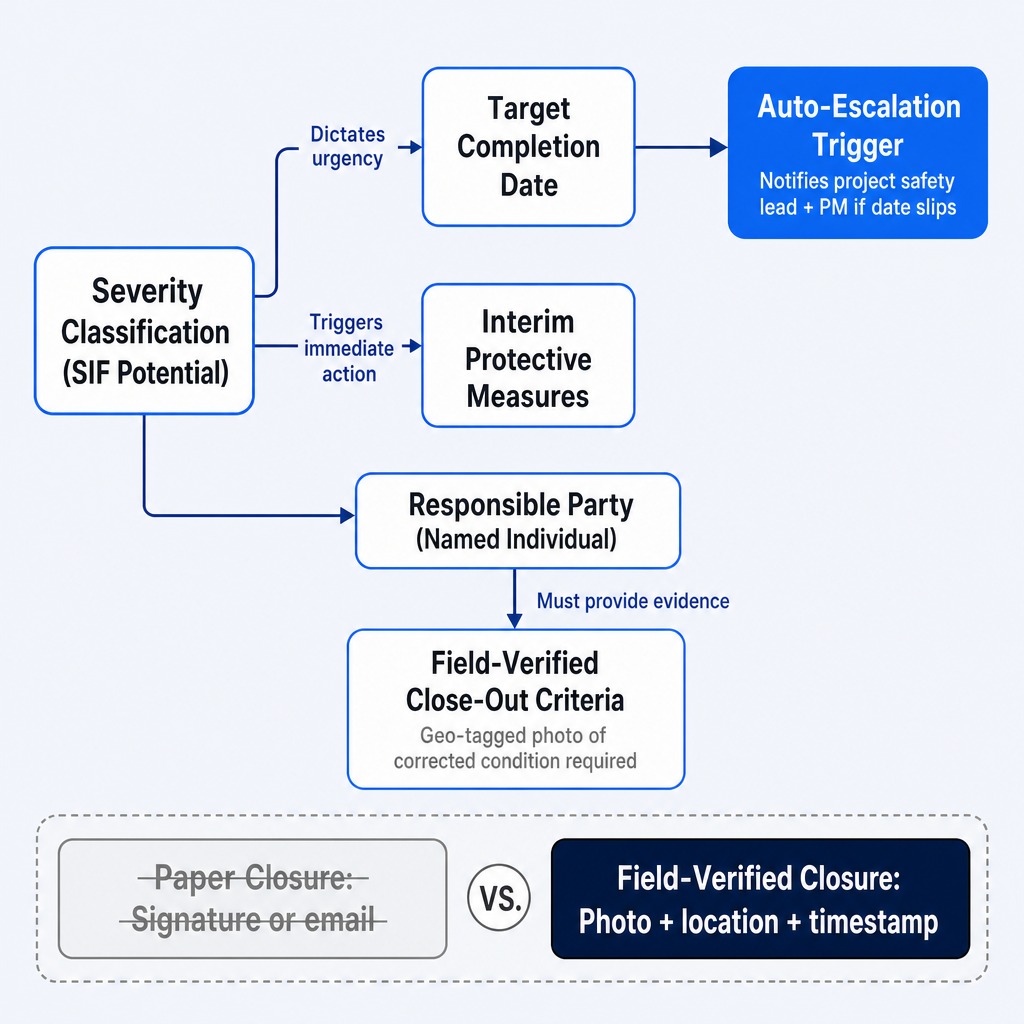
An effective corrective action plan becomes a tool for accountability by including components that are often missing from standard templates:
- Severity Classification: Classify every finding by its potential to cause a serious injury or fatality. The deciding factor is how severe the outcome could be if an incident occurred, even when the likelihood looks low. This classification sets the urgency and escalation path.
- Interim Protective Measures: Until someone engineers or installs a permanent fix, crews working in the area still need protection. The plan should specify immediate actions, like barricading an area or taking equipment out of service, that reduce the exposure until the final correction is in place.
- Responsible Party Assignment: The plan should assign responsibility to a specific individual with the authority and resources to execute the fix. Assigning an action to a company or a title like “Site Superintendent” leaves room for everyone to assume someone else has it.
- Target Completion Date: A realistic but firm deadline is essential, backed by an escalation trigger. If an abatement date slips on a high-potential finding, the notification should go to the project safety lead and the project manager without anyone having to send it.
- Close-Out Criteria: The plan has to define what “done” looks like, and a signature alone doesn’t meet that bar. Effective criteria require field-verified evidence, like a close-out photo of the new guardrail or a competent person’s sign-off at the location of the repair.
Corrective Action Versus Preventive Action in Safety Programs
A corrective action responds to a nonconformance someone has already identified, like a failed inspection, a near miss, or an observed hazard, which makes it reactive by nature.
Preventive action aims to eliminate the cause of a potential nonconformance before it occurs. Strong safety programs feed the trend data from their corrective actions directly into preventive action planning.
Repeat findings in the same hazard category, or a cluster of similar issues during one project phase, point to a systemic weakness. A preventive action would then target that system, for example by improving the Pre-Task Planning process or updating a design standard, instead of fixing the individual findings one by one.
Why Most Corrective Actions Die on the Aging Report
Open item aging is when corrective actions sit past their due dates on a tracking log while the hazard stays in place in the field.
A supervisor logs a finding, someone assigns an action, and then it sits on a spreadsheet. The weekly aging report grows longer, and safety meetings can turn into a ritual of reading the same list of overdue items.
On a large industrial project with seven subcontractors sharing a pipe rack area, a week of walkthroughs could easily produce forty-plus open corrective actions. Without a clear ownership protocol, the aging report balloons. A general contractor safety lead pulling the weekly report might find fourteen items assigned to one subcontractor marked “in progress” for three straight weeks with no photo verification and no field follow-up.
Eventually, someone closes the items administratively because the project phase moved on or the subcontractor demobilized, even if no one fixed the hazard. Four systemic issues tend to drive this pattern:
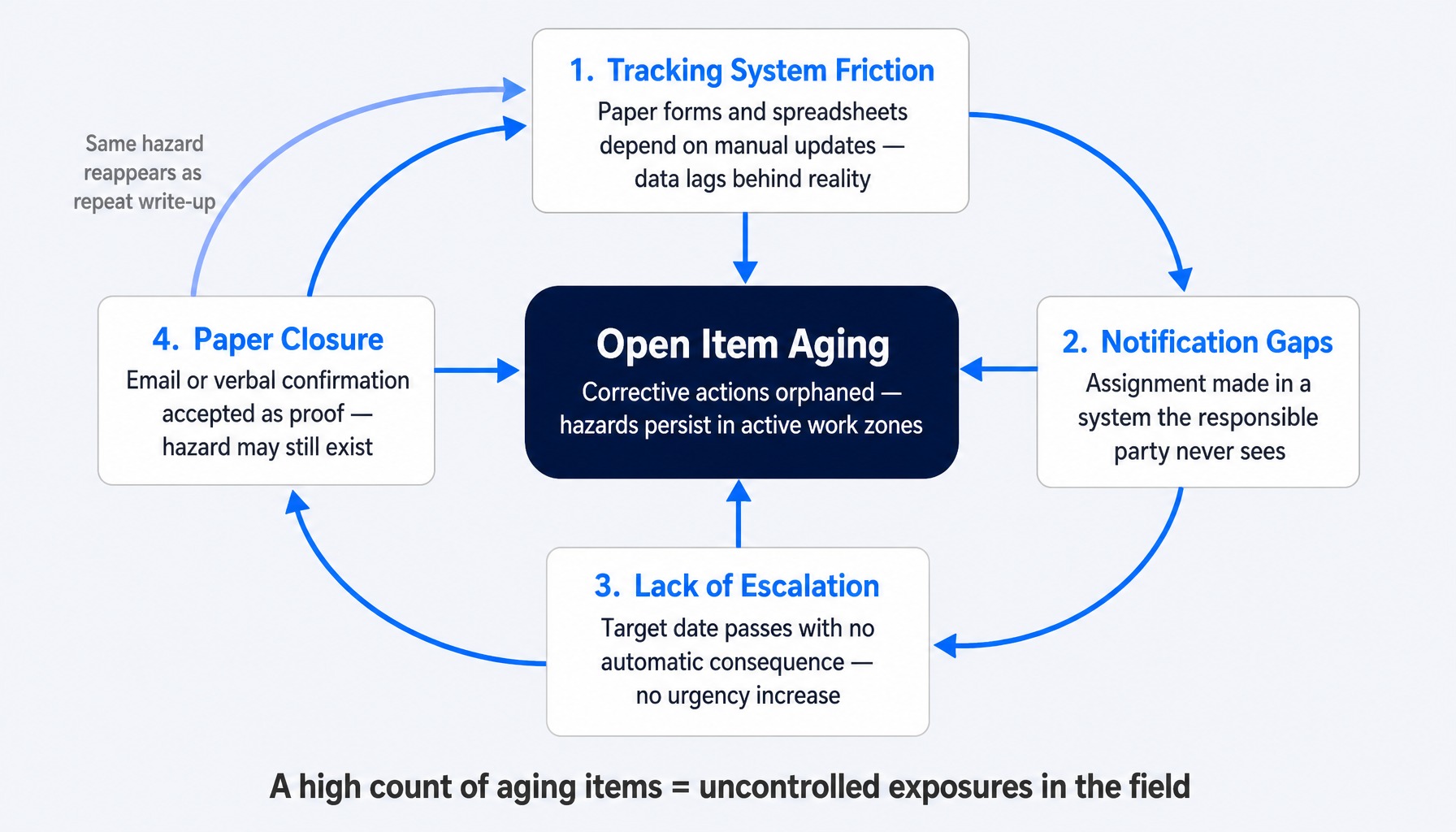
- Tracking System Friction: Paper forms and spreadsheets depend on manual updates. A supervisor who fixes an issue in the field has to remember to call, email, or stop by the trailer to report it, so the data tends to lag behind reality.
- Notification Gaps: Someone assigns the action in a system the responsible party never checks, or in an email they miss during a busy shift.
- Lack of Escalation: The target completion date passes with no automatic consequence. Nothing elevates the overdue item to the next level of management, so it remains a line item on a report with no increasing urgency.
- Paper Closure: The close-out process accepts an email or a verbal confirmation as proof of completion. That lets the same hazards come back on later walkthroughs as repeat write-ups.
A rising count of aging items is a leading indicator that findings aren’t turning into fixes. Moving from paper forms to construction safety management software removes much of this friction by digitizing the workflow from capture to close-out.
Starting Corrective Actions from Frontline Field Data
Corrective actions written from photos, locations and crew descriptions name the exact condition to fix and the crew it put at risk.
A finding captured as a one-line spreadsheet entry, like “fall protection issue on level 3,” produces a vague corrective action that is nearly impossible to execute without a follow-up visit.
A geo-tagged photo of the missing guardrail section, a voice note from the worker describing the crew exposed nearby, and a timestamp turn that same finding into a corrective action that is specific, contextual, and actionable. The plan can name the exact condition, location, and exposure because the initial data was rich and unambiguous.
Grounding Root Cause Analysis in Field Observations
Root cause analysis works best with data captured when and where the hazard showed up. Too often, investigations depend on supervisor interviews and post-event summaries. Photos, videos, and firsthand voice descriptions from the person who identified the hazard give any cause analysis an objective starting point.
The same field data supports a simple five whys or one of the techniques covered by the International Electrotechnical Commission’s IEC 31010 standard, like Ishikawa (fishbone) analysis.
This data also enables an important diagnostic step: the Pre-Task Plan tie-back. By comparing the timestamped observation to the Pre-Task Plan for that crew and shift, a safety leader can tell whether the crew identified the hazard during planning and the control failed, or never anticipated it at all. Those are two different root causes that call for different corrective actions, one aimed at an execution failure and the other at a planning gap. For more on what a strong plan looks like, see how Pre-Task Plan quality scores signal jobsite risk.
Close-Out Criteria That Require Field-Verified Evidence
Paper closure and field-verified closure differ in what counts as proof. Paper closure means a supervisor signs a form or sends an email. Field-verified closure requires objective evidence from the location of the fix, like:
- A timestamped and geo-tagged close-out photo showing the corrected condition.
- A follow-up inspection or observation that a competent person logs at the site.
- A sign-off in a digital system that won’t close the item until someone attaches that evidence.
Field-verified closure also lines up with OSHA’s abatement verification rule, which requires employers to certify that they corrected cited violations and, for willful, repeat, and some serious violations, to submit documentation that can include photos or video. It changes behavior, too, because a photo requirement for closure discourages the “pencil-whipping” of corrective actions. As a rule, any corrective action classified as high severity or tied to one of the OSHA Focus Four hazards (falls, struck-by, electrocution, and caught-in or -between) should require photographic evidence of abatement before anyone can close it.
How Corrective Action Trend Data Exposes Controls That Are Sliding Down the Hierarchy
Corrective action trend data groups findings by hazard type and control level, showing whether fixes move up or down the hierarchy of controls.
A close-out rate on its own can be misleading. A program can report closing 95% of its corrective actions on time while the underlying risk on site is actually increasing. That happens when the closed items are mostly low-severity housekeeping findings, while high-potential exposures either age on the log or end with a weak administrative fix.
A program where repeat fall hazard findings keep producing corrective actions that call for toolbox talks or new signage is sliding down the hierarchy. Even if the close-out rate looks healthy, the reliance on administrative controls over engineering solutions means the exposure persists.
Track corrective actions tied to serious injury and fatality precursors, like high-potential near misses, separately and escalate them faster. A low recordable rate can easily coexist with a high number of those precursors, and aggregate close-out metrics won’t surface that gap.
Tracking Corrective Actions Across Subcontractors on Trade-Stacked Sites
On large projects, corrective action ownership can become unclear as soon as multiple subcontractors start working in the same area.
A finding in a shared zone, like inadequate barricading around a floor opening, could involve the trade that created it, the trades working near it, and the general contractor responsible for overall site safety.
When a corrective action plan assigns responsibility to “the sub” or “site safety,” it creates a buy-in gap where no one acts because no one feels true ownership. Subcontract language alone often doesn’t settle who owns a corrective action in a shared work zone, so the general contractor needs a site-specific protocol and has to enforce it.
Breakdowns in permit-to-work systems often create these conditions, since overlapping permits can lead to conflicting activities in a shared space. For more on keeping ownership clear as crews and projects multiply, see our guide to scaling construction safety management.
On these sites, effective corrective action planning requires:
- Specific Assignment: The plan names the specific subcontractor entity and the individual responsible party.
- Clear Authority: The person named has the authority to direct the work needed for the fix.
- Defined Escalation: The plan includes an escalation path to the general contractor’s project team if the subcontractor doesn’t act within the target window.
Learning teams can carry the lessons from a corrective action on one part of a project to every subcontractor on site and to future projects in the portfolio.
From Aging Report to Verified Closure with Safety Mojo
The central challenge of any corrective action plan is closing the gap between a finding captured in the field and a verified fix. That process breaks down when it relies on manual handoffs, spreadsheet tracking, and paper-based approvals. Safety Mojo supports each stage:
- Flex PTP reads the paper, whiteboard, or PDF Pre-Task Plans crews already use and scores each one for the quality of its hazards and controls. When a finding comes in, safety leaders can check it against that crew’s plan for the shift and see whether the crew planned for the hazard and missed it in execution, or never identified it at all.
- My Day Dashboard gives leadership one view of open corrective actions across every jobsite, filterable by site, severity, or owner, with alerts when items go overdue. Supervisors can open any item to see the original form, photos, comments, and status, so they can check the close-out photo before signing off.
- Risk Feed ranks the highest-priority items from the Pre-Task Plans, observations, near misses, and incident reports crews submit each day, with the reasoning behind each flag and a suggested next step. Safety directors can follow up on high-potential exposures before the next crew rotation inherits them, instead of waiting for the weekly aging report.
Frequently Asked Questions
How long should a corrective action stay open before escalation?
Tie escalation timelines to severity. Set the shortest window for high-severity items linked to OSHA Focus Four hazards or serious injury and fatality precursors, and a longer one for low-severity items. Any item that slips past its target completion date without a documented reason should escalate to project leadership automatically.
How do learning teams feed findings into corrective action plans after near misses?
Learning teams look at near misses to identify systemic factors beyond the immediate hazard. Their findings should generate corrective actions that target those causes, like gaps in process or communication. Share those actions across the entire project portfolio. A single-site corrective action then becomes a portfolio-wide preventive action.
What role does permit-to-work data play in triggering corrective actions?
Permit-to-work breakdowns, like overlapping hot work permits or failure to verify adjacent trade activity, often create the hazardous conditions that corrective actions later address. Treating permit data as an upstream trigger lets safety teams issue corrective actions against the permit process itself, which does more to prevent recurrence than fixing each resulting hazard in isolation.
How do high observation counts mask weak corrective action follow-through?
Quota-driven observation programs can generate hundreds of low-severity findings that are easy to close, inflating close-out rates and creating a false sense of security. Meanwhile, high-potential findings that require complex corrective actions age on the log. Leaders should track corrective action metrics by severity tier so high-potential items can’t hide inside a single aggregate number.
How should corrective action plans adapt when site conditions change mid-project?
A corrective action written for one project phase may lose relevance as new trades mobilize or work sequences change. Plans should include a re-evaluation trigger tied to major scope changes. Flag previously closed items for review if the same hazard category shows up again in a later phase of work.
What is the best way to tie corrective actions back to Pre-Task Planning on active jobsites?
Corrective action items should feed into daily Pre-Task Plans. When the crew working in an affected area sees the finding and the required control before their shift starts, the plan moves from a tracking log into the daily workflow. That requires the corrective action system and the Pre-Task Planning tool to share data.


