

Key Takeaways
- A job safety analysis tends to fall behind when crews treat it as a one-time compliance document, so it stops matching site conditions as they change.
- On multi-contractor sites, single-trade JSAs often miss hazards from concurrent operations and trade stacking, which can leave line-of-fire and energy exposures in shared spaces uncontrolled.
- Generic control language like “maintain awareness” can satisfy a checkbox while hiding serious injury and fatality precursors, because it doesn’t name a verifiable action against the energy source.
- An effective JSA program needs a feedback loop where observations and near misses trigger revisions, so the JSA keeps pace with the work.
- The Occupational Safety and Health Administration doesn’t require a document called a JSA, but a generic JSA that doesn’t match the work on site can undercut the evidence that the employer identified hazards and communicated them to crews.
Why a Job Safety Analysis Falls Behind the Work
A job safety analysis gives a crew a step-by-step plan for the hazards in a task before the work starts. On a complex, multi-contractor project, though, the JSA a crew reviewed before starting a task can bear little resemblance to the hazards it faces by midday.
That drift tends to happen when site conditions change or another trade moves into an adjacent area.
That disconnect turns the JSA from a frontline planning tool into a compliance artifact. A JSA full of generic language that doesn’t reflect conditions on site can also become a liability if an OSHA compliance officer reviews it during an inspection. The gap between the JSA on paper and the work in front of the crew is where serious incidents tend to start, and closing it means keeping the JSA current as the work changes.
What Is a Job Safety Analysis in Construction?
A job safety analysis breaks a task into steps, names the hazards in each step, and assigns a control to each hazard before work begins.
OSHA’s guidance focuses on a closely related document, the job hazard analysis, and projects that follow the U.S. Army Corps of Engineers’ EM 385-1-1 safety manual require an activity hazard analysis. Some companies use these terms interchangeably, while others treat the JHA as a broader review of a job’s hazards and the JSA as the step-by-step plan for a specific task. It’s worth confirming which document a contract or owner’s safety program actually requires.
OSHA’s job hazard analysis guide, Publication 3071, presents that process as a way to identify hazards before they occur. A JSA and a Pre-Task Plan cover different time frames, so crews use them together.
Subcontractors often develop the JSA before a task starts on a project and revise it as conditions change. Each shift’s PTP then references the JSA in a crew-level briefing focused on that day’s specific exposures, personnel, and work environment. Mixing up the two can lead to duplicated paperwork that crews resent, or to gaps where neither document addresses the day’s real hazards.
Read more: How PTP Quality Scores Expose Jobsite Risk
Where Job Safety Analysis Breaks Down on Multi-Contractor Sites
Job safety analysis breaks down on multi-contractor sites when each trade plans its own task and no one reconciles the plans for shared space.
JSA templates tend to assume a single trade working in an isolated area, and that assumption can break down daily on a project with concurrent operations. This is especially true on hyperscale and data-center construction projects, where compressed schedules put multiple subcontractors in close proximity. The JSA for one crew’s overhead mechanical installation might not account for the fire protection crew hanging pipe in the same overhead space or the electrical crew working on panels below.
Trade Stacking and the Single-Trade JSA Assumption
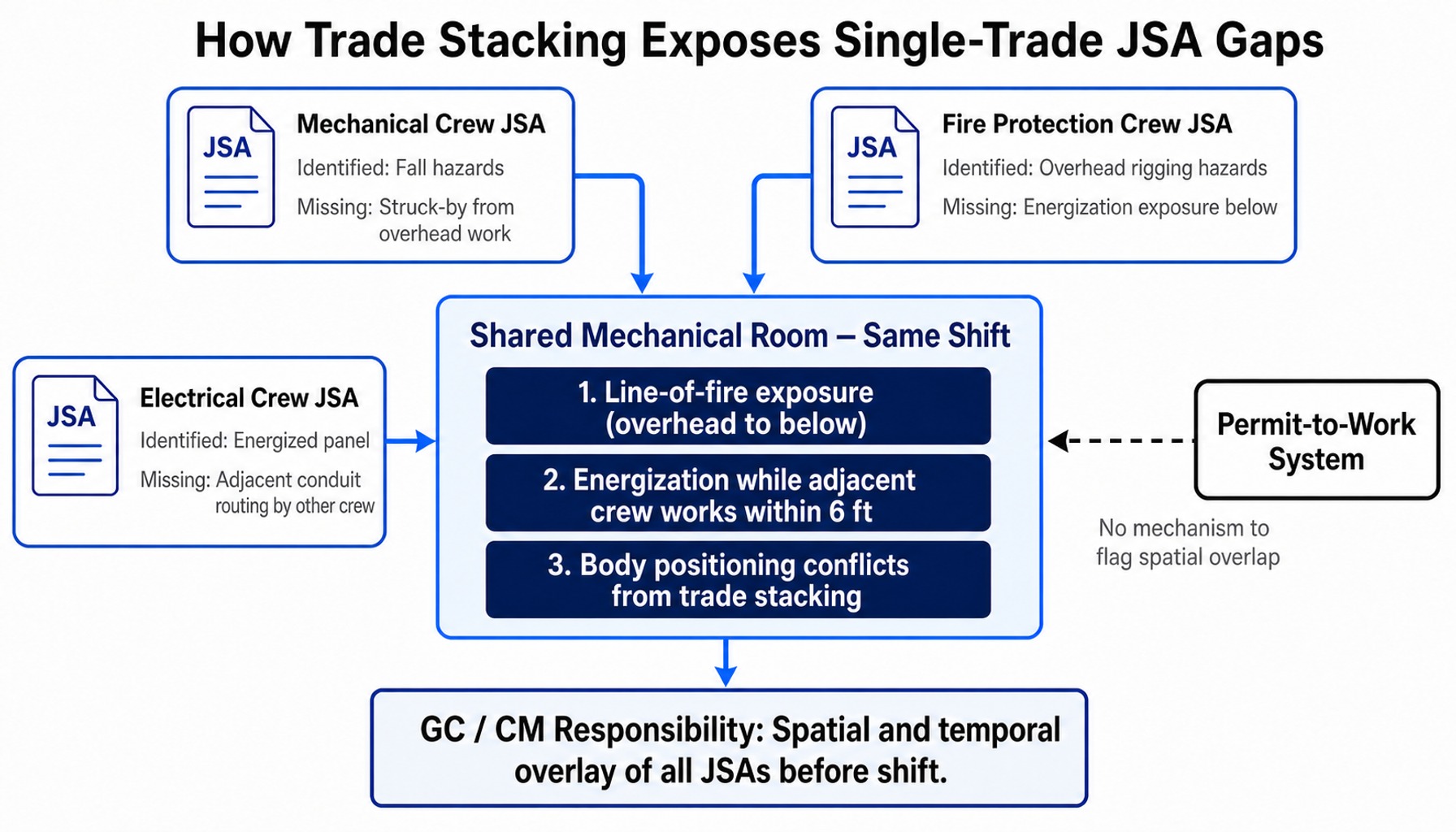
Trade stacking, where multiple trades occupy the same physical space during the same shift, can quickly expose the limits of a single-trade JSA. On a large data-center build with 40 or more active subcontractors, three separate crews could submit JSAs for work in the same mechanical room on the same shift. Each JSA might identify different hazards without referencing the other trades, and a permit-to-work system with no way to flag the overlap would let all three proceed.
A near miss in that setting could look like an electrical crew energizing a panel while a second crew, six feet away, is still routing and terminating conduit for circuits fed from that panel.
Each of the three JSAs could look complete on its own, because the gap only shows up when someone checks all three against the day’s work plan. In this case, the mechanical crew’s JSA might identify fall hazards and say nothing about the struck-by exposure from fire protection hangers going in overhead. Trade stacking adds line-of-fire and body positioning risks that stay invisible while each trade scopes its analysis to its own task boundaries.
JSA review on multi-contractor sites needs an overlay of both space and timing, and that responsibility falls on the general contractor or construction manager.
Permit-to-Work Handoffs That JSA Data Should Inform
On large industrial and construction sites, the permit-to-work system and the JSA process often run in parallel without informing each other. A safety team might issue a hot work permit for a corridor while the adjacent crew’s JSA for cable tray installation in that same corridor never references the hot work boundary or the fire watch requirement. This disconnect tends to happen because different people often manage permits and JSAs on different systems, and daily planning meetings rarely cross-reference the two.
The JSA holds data that should feed directly into permit coordination, including the location, timing, and hazard profile of each task. A permit authorizes work under specific, controlled conditions, like verified energy isolation before electrical work or a fire watch during hot work, while the JSA details the step-by-step hazards a crew will face doing that work.
When no one connects the two systems, each provides only a partial picture of risk, and crews can face hazards that one system flagged and the other never received.
How Generic JSA Language Hides Serious Injury and Fatality Precursors
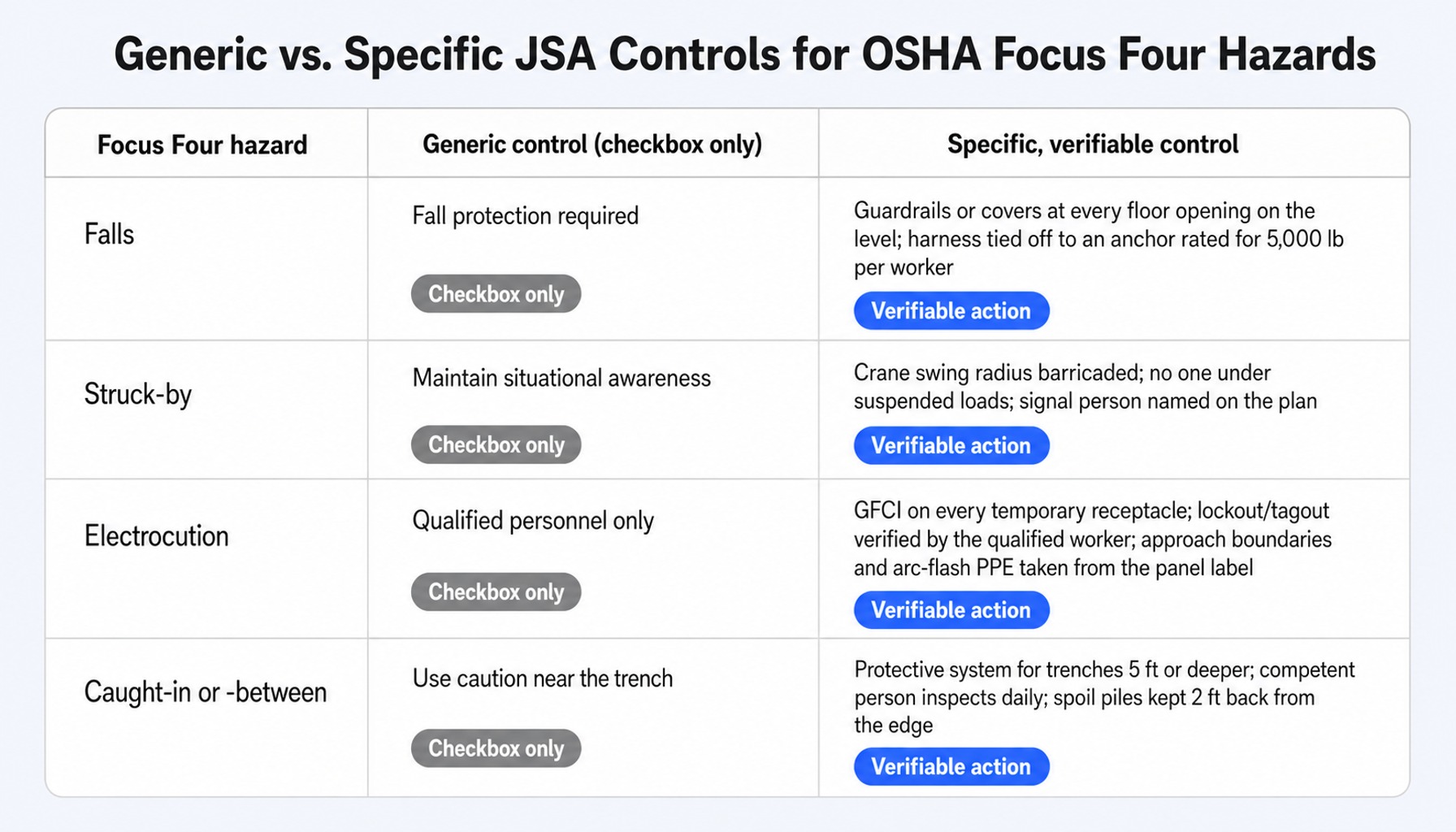
Generic JSA language can hide serious injury and fatality precursors when a control names a behavior instead of a verifiable action.
A document with every box filled can still mask SIF precursors if the controls consist of generic administrative language. Phrases like “maintain situational awareness,” “use caution,” or “wear proper personal protective equipment” satisfy a checkbox without telling the crew what to physically do. That gap matters most when the underlying hazard involves one of OSHA’s Focus Four: falls, struck-by, electrocution, and caught-in or -between.
A JSA for work near an energized panel might list “qualified personnel only” as the control, but without the approach distance, the voltage level, or the arc-flash PPE requirements, the exposure remains uncontrolled. Organizations with low recordable incident rates can still carry high SIF potential if their JSAs use language that obscures the severity of the exposure.
Reviewing JSAs for SIF precursors means looking past whether the JSA lists a hazard and checking whether the control names a specific action tied to the energy source. Prevention through Design, the approach behind the ANSI/ASSP Z590.3 standard, follows the same logic: it starts with the most effective controls in the hierarchy of controls, like eliminating a hazard or engineering it out, before relying on administrative rules and PPE.
Closing the Loop: How Field Data Makes JSAs Evolve
Field data keeps a JSA current when observations, hazard reports, and near misses feed back into revisions as conditions change.
A JSA that no one revises after mobilization still reflects the assumptions the crew made on the first day.
This feedback loop tends to break down when observation programs are volume-driven. High observation counts look good on a dashboard but can reflect quota-driven reporting, where crews submit the required number of low-severity findings to satisfy a metric. An observation like “housekeeping issue in corridor B” gives a JSA author nothing to act on, while “unsecured penetration cover on level 3 near active overhead rigging” points to a specific revision.
Learning Teams After Near Misses: Pressure-Testing the JSA
A team safety meeting after a near miss can be one of the strongest triggers for a JSA revision. It works as a facilitated, blame-free discussion with frontline workers and supervisors about what the JSA assumed, what actually happened, and what the gap reveals about the controls.
A general contractor running learning teams across subcontractors can use the findings to revise the JSA for the affected task along with similar JSAs across the project portfolio. The output of a learning team should be a specific JSA revision with a named owner and a deadline, which turns a single near miss into a systemic improvement. A corrective action plan can track those revisions to completion.
Read more: Learning From Past Incidents Toolbox Talk
What OSHA Expects from a Job Safety Analysis During an Inspection
OSHA expects employers to identify, control, and communicate hazards before work begins, though no standard requires a JSA by name.
In construction, 29 CFR 1926.21(b)(2) requires employers to instruct each employee in recognizing and avoiding unsafe conditions. For general industry, 29 CFR 1910.132(d) requires a workplace hazard assessment to determine the necessary PPE.
A compliance officer reviewing hazard planning will typically look for evidence that the employer identified hazards before work began, selected controls and communicated them to crews, and matched the assessment to actual site conditions. The bigger inspection risk is a JSA that doesn’t match what the crew was actually doing. A JSA that lists “fall protection required” for a task performed at grade raises questions about whether anyone reviewed it.
A JSA that names a competent person who wasn’t on site that day points to the same kind of breakdown.
How Safety Mojo Keeps the JSA Connected to What Is Actually Happening
Manual paperwork tends to pull a JSA away from field conditions. Rewriting a JSA in the field with gloves on can be impractical, so a crew might sign the generic version instead. Safety Mojo aims to reduce that friction without asking crews to change the forms they already use.
- Flex PTP reads paper, whiteboard, or digital PTP and JSA forms from a photo and scores each one for the quality of its task steps, hazards, controls, and PPE. A safety director can see which crews’ plans lean on generic controls like “use caution” and coach those crews before the work starts.
- My Day Dashboard shows PTPs, permits, observations, and open corrective actions across every jobsite in one view, and flags plans that involve high-risk activities like crane lifts as they come in. A GC safety manager can see which crews have high-risk work planned that day and check whether their JSAs account for each other.
- Risk Feed ranks the highest-priority items from the PTPs, observations, near misses, and incident reports crews submit, with the reasoning behind each flag and a suggested next step. An observation of an unsecured floor penetration near active rigging can surface near the top of the feed, so the safety director can ask every crew on that level to revise its JSA before the next shift.
Book a call to see how Flex PTP works in a live project walkthrough.
Frequently Asked Questions
How should a job safety analysis account for weather changes or adjacent crane operations mid-shift?
A JSA needs a documented revision when conditions change materially, like high winds exceeding lift-plan thresholds or a crane mobilizing into an adjacent zone. The revision should name the new hazard, the additional control, and the crew member responsible for verifying it. If the crew can’t revise the JSA quickly, it should use stop-work authority until someone controls the hazard.
How do general contractors verify that subcontractor JSAs reflect actual field conditions?
Verification typically involves Pre-Task Plan spot checks and field walk-downs that compare the written JSA to the work in progress. A JSA that names the actual floor level, adjacent trades, and specific equipment tends to be far more credible than one using generic language. A GC can also require subcontractors to submit JSAs through one shared system, so the safety team can spot stale documents before work starts.
What makes a job safety analysis effective on data-center and hyperscale construction projects?
On these projects, a JSA has to account for heavy trade stacking in plenums and overhead zones where mechanical, electrical, and fire protection crews share space. Effective teams revise JSAs at the area level as well as the trade level and coordinate them in daily planning meetings that overlay each crew’s scope and timing to identify hazards from concurrent operations.
How often should a job safety analysis be updated on an active construction site?
OSHA doesn’t set a fixed schedule for JSA updates. Crews should revise a JSA whenever the scope, sequence, equipment, or site conditions change materially from what the original analysis assumed. On dynamic sites, that can mean daily revisions for high-risk tasks, because the trigger is a change in the hazard profile.
What is the difference between a JSA and a JHA?
The two terms don’t have one agreed definition. Some companies use them interchangeably, while others treat the JHA as the broader review of a job’s hazards and the JSA as the step-by-step plan for a specific task. Check which document a contract or owner’s safety program requires, since the expected format can differ.


