

Key Takeaways
- Plan inspection routes daily by reviewing Pre-Task Plans and active permits, so the walk targets the areas with the highest energy and risk that day.
- Verify life-critical controls for the Occupational Safety and Health Administration’s Focus Four hazards. Physically check fall protection anchorages, excavation protective systems, and temporary electrical protection instead of stopping at whether crews are wearing personal protective equipment.
- Separate serious injury and fatality precursors from routine findings. A missing guardrail at a leading edge calls for a different, immediate response than a housekeeping issue.
- Judge observations by quality. A high volume of low-value entries, like “worker wearing PPE,” can hide a lack of visibility into high-potential hazards.
- Document every finding with a timestamped photo, and give each corrective action an owner, a due date, and a verification step. Tracking how long actions stay open keeps accountability visible.
Why It Takes More Than a Checklist to Inspect a Construction Site for Safety
Construction site safety inspections can produce a completed checklist without changing conditions on the ground. For teams working out how to inspect a construction site for safety on a complex, multi-trade project, that gap can show up fast.
The inspector files the form, the same hazards reappear the following week, and leadership might see green metrics while frontline risk persists. A scaffold crew might pull a guardrail section to land material while temporary power runs through a wet area two bays over.
Generic checklists don’t rank which exposure to address first, and they don’t connect either finding back to the Pre-Task Plans the crews reviewed that morning. When findings sit in paper binders or disconnected spreadsheets for days, corrective actions stall and high-potential exposures can persist through multiple shifts.
The site-level risk assessment the project team completes before work begins sets the hazards and controls a project plans for. Inspections during the job check whether those controls are actually in place as the work and site conditions change.
A strong inspection on a multi-trade project depends on four things: route planning, physical checks of life-critical controls, severity ranking for findings, and corrective action closeout.
Planning the Inspection Route Before the Walk
A good inspection route starts from the day’s active work, open permits, and highest-risk zones, so the walk covers what changed overnight.
Inspection failures can start before the inspector leaves the trailer. Walking the same loop at the same time every day creates a predictable blind spot that crews can learn to work around.
An effective construction site safety inspection begins with the work actually happening that day: which trades are active, where energy isolation points exist, where crane swing radius zones overlap with foot traffic, and which hot work permits are open.
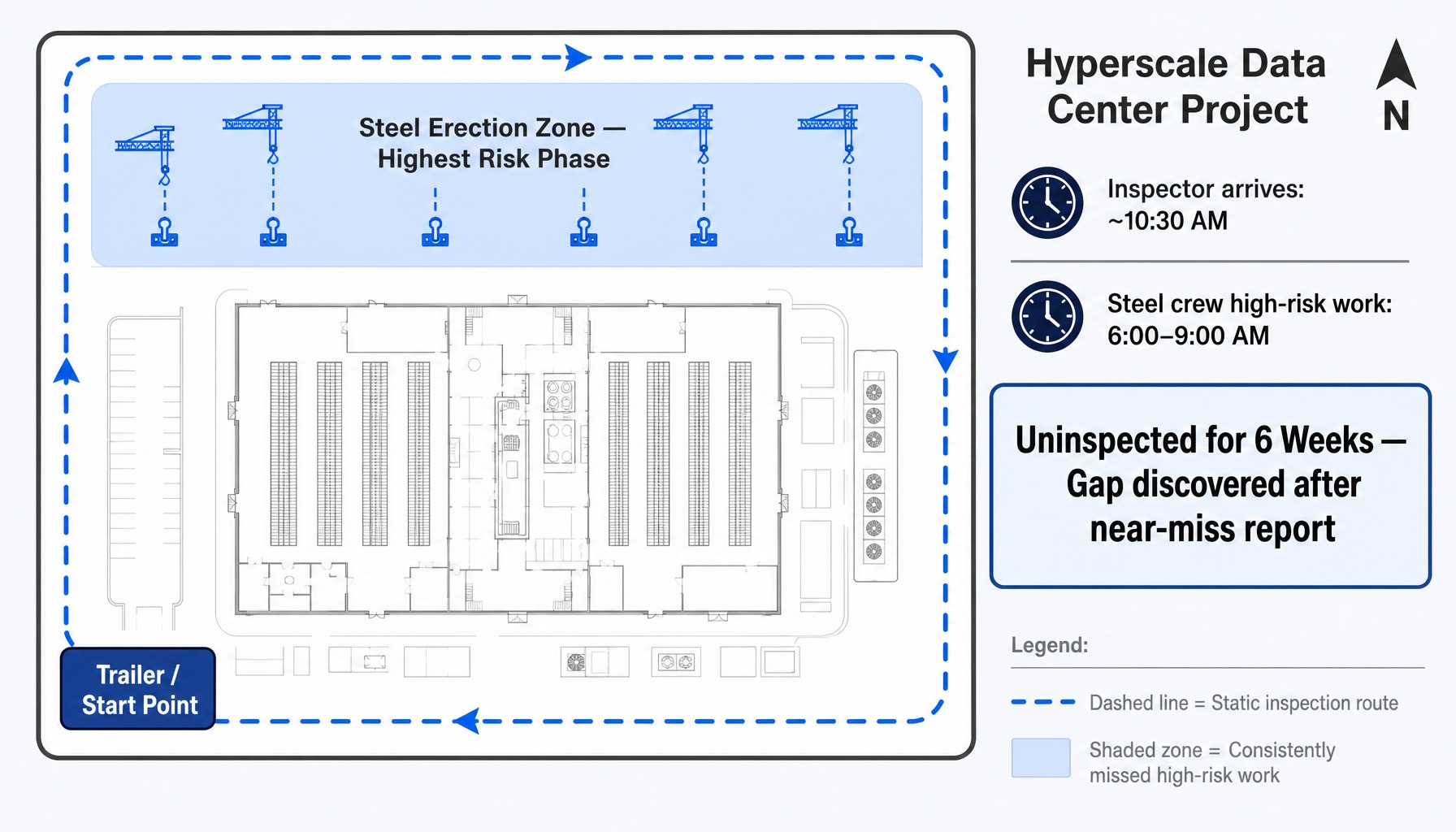
On a hyperscale data center build, a fixed clockwise route can leave the same gap open for weeks. If the steel erection crew on the north end finishes its highest-risk work before the inspector arrives each morning, no one checks its fall protection anchorages and leading-edge guardrails during active work.
The inspection log can show full coverage while the highest-risk phase goes uninspected, and the gap may only surface after a near-miss report.
Connecting Pre-Task Plans to Walkthrough Targets
The Pre-Task Plans crews submit each morning are a strong guide to where the inspection should go. Those plans show where high-energy work like steel erection, concrete pours, or electrical tie-ins is happening on a large project with more than a dozen active trades. An inspector who reviews them before walking the site can head straight to the zones with the highest exposure potential.
Safety leaders who capture daily plans digitally can see where crews have scheduled high-risk work before the walk starts. The inspection then becomes a check on the controls crews said they would put in place.
Read more: How Pre-Task Plan Quality Scores Expose Jobsite Risk
Checking the Competent Person’s Inspections During the Walk
Each subcontractor’s competent person runs the trade-specific inspections OSHA requires, and the GC’s walk should confirm they happened.
OSHA defines a competent person in 29 CFR 1926 as someone capable of identifying existing and predictable hazards who also has the authority to take prompt corrective measures. Standards for excavation, scaffolding, and fall protection all depend on this role, and a general safety walkthrough can’t substitute for that trade-specific evaluation.
The general contractor’s safety team on a multi-employer worksite should verify that each subcontractor has a designated competent person on-site who has already inspected their own work area and equipment. The GC’s walk adds a second layer on top of each subcontractor’s own inspections.
During the walk, the inspector should ask to speak with the competent person for the excavation or scaffold and confirm they completed the required inspection, which is daily for excavations and before each shift for scaffolds. Having them walk through the specific hazards and controls for their scope shows whether their inspection covered what matters.
Verifying Life-Critical Controls Across the Focus Four Hazards
Life-critical controls are the guardrails, anchorages, trench protection, and electrical safeguards that stand between a crew and a fatal event.
OSHA’s Focus Four hazards are falls, struck-by, electrocution, and caught-in or -between. Together they accounted for 56% of construction worker deaths in 2023. A construction site safety inspection checklist is most useful when the inspector knows what to physically verify for each one.
- Falls: Fall protection checks start at the anchorage and the guardrail, since a worn harness only helps if it’s tied off to something that holds. The inspector should check the condition of guardrail systems, including top rail height, midrails, and toeboards, especially at leading edges and floor openings. For personal fall arrest systems, the critical check is the anchorage. OSHA’s fall protection standard requires anchorages that support at least 5,000 pounds per attached worker or that are designed as part of a complete system with a safety factor of at least two under a qualified person’s supervision.
- Struck-By: Struck-by hazards are common around heavy equipment and material handling. For crane operations, the inspector should confirm that control lines, warning lines, railings, or similar barriers mark the swing radius and that the barricade still stands after deliveries and trade moves. A signal person should be in place whenever the operator can’t see the load path. Vehicles with an obstructed rear view need a working reverse alarm or an observer, and crews should clearly mark pedestrian walkways and keep them clear of equipment.
- Electrocution: Temporary electrical systems can expose workers anywhere cords and panels run. OSHA requires either ground-fault circuit interrupters or an assured equipment grounding conductor program on construction sites. The inspector should confirm GFCI protection on temporary receptacles, or, where a contractor relies on the assured grounding program instead, check its written program and test records. Extension cords should be designed for hard or extra-hard usage and free of damage.
- Caught-In or -Between: Trench collapses pose the greatest risk to workers’ lives in excavation work. Excavations 5 feet or deeper need a protective system unless they’re in stable rock, and shallower ones need one when a competent person sees signs of a potential cave-in. The key verification is asking the competent person how they classified the soil and confirming that the shoring, sloping, or benching matches that classification. A finding that just says “shoring required” leaves the crew guessing. “Trench wall shows fissuring and sloughing, no protective system installed, two workers in the trench” tells them exactly what to fix.
What to Include in a Construction Site Safety Inspection Checklist
A construction site safety inspection checklist should cover core hazards, active permits, access, equipment, and finding details.
A checklist works best as a prompt for what to verify, with room to record what the inspector actually found. The areas below tend to matter most on a multi-trade project:
- Fall protection: Guardrails at leading edges and openings, floor hole covers that are secured and marked, anchorages, and ladder condition and setup.
- Scaffolds: Competent person inspection before each shift, full planking, guardrails, and safe access.
- Excavations: Protective systems, spoil piles set back from the edge, safe access and egress, and the competent person’s daily inspection.
- Cranes and rigging: Swing radius barricades, rigging condition, and a signal person where the operator’s view is blocked.
- Vehicles and equipment: Reverse alarms or observers, and pedestrian routes separated from equipment traffic.
- Temporary electrical: GFCI protection or an assured grounding program, cord condition, and panel covers in place.
- Hot work and fire prevention: Open hot work permits, fire watch, extinguishers, and the status of fire protection systems in the area.
- Permits and trade stacking: Active permits checked against each other for shared space and timing.
- Housekeeping and access: Clear walkways, debris control, and adequate lighting.
- Finding fields: A serious injury and fatality precursor flag, plus a corrective action owner and due date for every finding.
Where Permit-to-Work Systems Break Down on Multi-Contractor Sites
Permit-to-work systems break down when valid permits conflict in the same space or time and no one catches the overlap.
Permit-to-work verification is one of the most important parts of a construction site safety inspection on a site with trade stacking. The breakdown tends to happen when two permits that are each valid on their own become incompatible once both crews work in the same space at the same time. The inspector’s job includes confirming that each permit’s conditions still hold given what other trades are doing nearby.
A mechanical contractor on a data center or industrial project might hold a hot work permit for welding on a mezzanine, and that permit assumes sprinkler protection in that zone is active. If the fire protection contractor drains that same zone for tie-ins the same morning, both permits are valid on paper, and no one has cross-referenced them.
An inspector who only checks for the hot work permit at the weld station would miss that the fire protection the permit relied on is out of service.
Effective permit verification requires awareness of both space and timing. It means checking the day’s permit log against the site map to find overlapping scopes before the walk begins.
The National Fire Protection Association’s NFPA 241, the standard for safeguarding construction, alteration, and demolition operations, treats impaired fire protection as a construction fire risk that project teams have to plan around. The inspector needs to check each hot work permit against everything else happening in the same area for that reason.
Why High Observation Counts Fail to Improve Hazard Visibility
High observation counts fail when they reward easy entries instead of showing where serious exposures are actually developing.
Observation volume serves as a primary leading indicator in some safety programs, with quotas that require supervisors to submit a certain number of observations per week. That approach can produce data that looks healthy while masking real risk.
When a quota is the main driver, supervisors tend to submit observations about positive compliance, like proper PPE use or good housekeeping, because those are the fastest to document and close. High-potential exposures, like inadequate energy isolation or a missing barricade at an excavation edge, can go unreported because they take longer to describe and may create friction with a subcontractor.
Inspections offer a direct way to test whether the observation program is seeing what matters. If inspectors keep finding unprotected leading edges or open trenches in areas where the week’s observations reported nothing but compliant behavior, the observation data isn’t reflecting field conditions.
A project with 500 observations a month and no near-miss reports involving life-critical controls likely has a reporting gap.
Leaders can measure observation quality with a few direct comparisons:
- The share of observations that identify serious injury and fatality precursors compared with routine conditions.
- The range of hazard categories reported across trades and work areas.
- How closely observations line up with the high-risk work scopes that were active that day.
- How often inspection findings appear in areas where no observation flagged a problem.
Separating Serious Injury and Fatality Precursors from Routine Findings
Inspectors should flag findings that could plausibly cause a fatality or permanent injury and route them separately from routine items.
A low total recordable incident rate can hide high-potential exposures that simply haven’t produced a serious event yet. Every construction site safety inspection needs to separate routine compliance findings from serious injury and fatality precursors. A SIF precursor is a condition where a slightly different outcome could have killed or permanently injured someone.
Inspection programs can end up weighing all findings equally. An inspector might log a missing hard hat and a missing guardrail at a leading edge as the same kind of “open finding,” which flattens their severity and keeps high-priority issues from getting the attention they need.
The dividing line is how close the finding sits to an uncontrolled energy source capable of causing irreversible harm. A suspended load moving over workers carries enough energy to kill someone, which puts it in a different class from a tripping hazard in a marked walkway.
Inspectors can sort each finding in the field with one question: Could this condition, unchanged, plausibly result in a fatality or permanent disability? A yes puts it in the precursor category and calls for a different response.
The crew stops work under stop-work authority while the finding goes to project leadership. The safety team then logs it in a separate SIF precursor register, apart from the general observation log. High-potential near misses captured this way also give learning teams useful material to analyze and share across a project portfolio.
Read more: Learning From Past Incidents Toolbox Talk
Documentation Standards and Corrective Action Closeout
Each inspection finding should carry a photo, a written description, a named owner, and a due date, then stay open until someone verifies the fix.
An inspection reduces risk when each finding becomes a documented corrective action that someone tracks to closure. A common failure mode runs like this: an inspector photographs a hazard, logs it on a paper form, and hands it to a superintendent who says the crew will fix it by the end of the day.
Three weeks later, the same condition shows up on the next inspection because no one tracked whether the crew completed the action or checked the fix.
Three documentation standards make inspections defensible and effective:
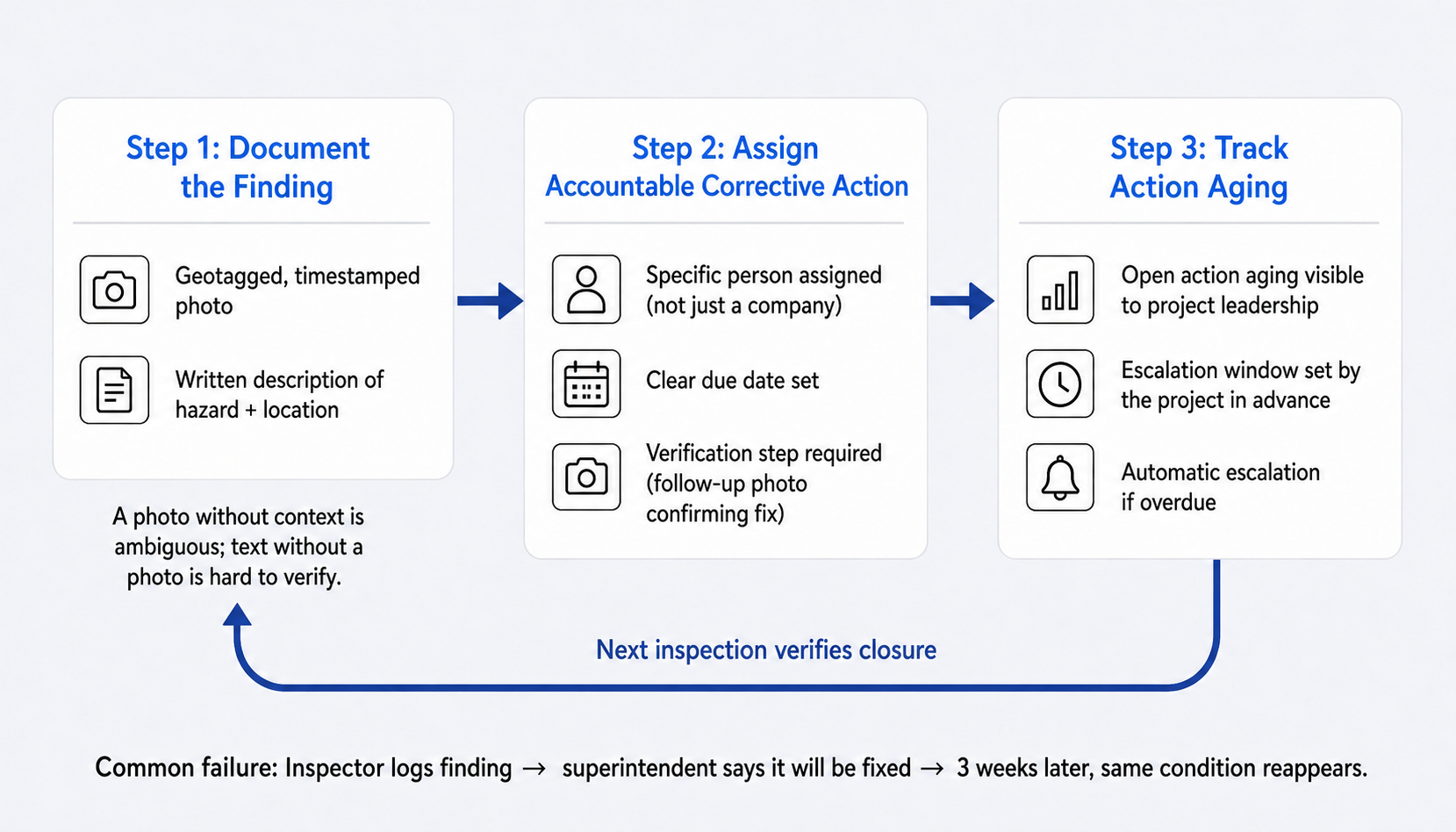
- Photo and Text Pairing: Every finding should include a geotagged, timestamped photo paired with a written description of the hazard and its location. Pairing the two lets anyone verify the condition and find it again later.
- Accountable Corrective Actions: Each corrective action needs a named owner at the responsible company, a clear due date, and a required verification step. That step usually means the owner submits a follow-up photo confirming the fix.
- Visible Action Aging: Open corrective action aging should be visible to project leadership. Actions that stay open past a window the project sets in advance, with the shortest window reserved for SIF precursors, should trigger automatic escalation.
These standards also produce well-organized records that hold up during client audits and OSHA inspections. For a deeper look at building and managing this process, see how to set up and follow a corrective action plan.
How Safety Mojo Closes the Gap Between Inspection Findings and Field Action
The inspection process tends to break down when it relies on paper forms, batch-entered observations, and manual follow-up. Here’s what closing that gap looks like in practice, using Safety Mojo as an example. The platform aims to shorten the time between finding a hazard and fixing it by putting frontline data in front of the people who act on it.
- Before the walk: Flex PTP reads the paper, whiteboard, or digital Pre-Task Plans crews already use, including any permit requests in them, and scores each plan for the quality of its hazards and controls. An inspector can see which crews have high-risk work scheduled and which plans look thin, then build the route around those areas.
- After the walk: My Day Dashboard shows PTPs, permits, observations, and open corrective actions across a project in one view. Supervisors can filter open actions by site, severity, or owner and get alerts when items go overdue, which keeps action aging visible without a separate spreadsheet.
- Between inspections: Risk Feed ranks the highest-priority items from the PTPs, observations, near misses, and incident reports crews submit, with the reasoning behind each flag and a suggested next step. Field leaders can follow up on high-potential exposures as they surface.
See how My Day Dashboard keeps open corrective actions and overdue items visible across every jobsite.
Frequently Asked Questions
How often should safety inspections be conducted on an active construction site?
OSHA requires frequent and regular inspections of job sites, materials, and equipment by competent persons, and some standards set specific intervals, like daily for excavations and before each shift for scaffolds. Beyond those minimums, frequency depends on the project phase and risk profile. Many general contractors pair daily walkthroughs with a formal documented inspection at least weekly, and high-hazard phases like steel erection or deep excavation may warrant checks several times per shift.
Who should conduct construction site safety inspections?
The general contractor’s safety team typically performs the overall site walkthroughs and checks how work areas, permits, and controls fit together across the project. Each subcontractor’s competent person handles the trade-specific inspections that the applicable OSHA standards require for their work and equipment.
How should inspection data connect to daily pre-task planning on construction sites?
Open corrective actions from the previous day’s inspection should feed directly into the next morning’s pre-task planning. If an inspection identified an unprotected floor opening, the crew working in that area the next day should see that finding in their plan and confirm the corrective action is in place before starting work.
How do safety teams inspect temporary electrical systems and ground-fault circuit interrupter protection on site?
Inspectors should verify that temporary receptacles have working GFCI protection and that extension cords are designed for hard or extra-hard usage and free of damage. Where a contractor uses an assured equipment grounding conductor program instead, OSHA requires a written program at the jobsite, daily visual inspections, and recorded tests at intervals of no more than three months. Crews should also test GFCIs with the built-in test button according to the manufacturer’s instructions.
What does a strong inspection process look like on a hyperscale data center construction project?
On hyperscale projects, multiple trades work at the same time in repetitive bays. A strong inspection process ties the walk route to the daily permit map and verifies that controlled access zones between bays hold up as trades rotate. It also tracks SIF precursors tied to overhead mechanical, electrical, and plumbing installation, like suspended loads, incomplete hangers, and energized busways near active work zones.


