

Key Takeaways
- A construction site risk assessment starts before work begins. Strong assessments are built during pre-bid and post-award planning, then checked in the field.
- Use a broad-to-specific process: review drawings and site constraints, break the work into task segments, review subcontractor Job Hazard Analyses, then verify the plan through daily Pre-Task Plans and field verification.
- Walk the site, identify hazards, rate them by likelihood and severity, record them in a risk register, and select controls using the hierarchy of controls.
- Separate hazardous conditions from behavior issues. Conditions usually point to planning failures. Behavior issues usually point to training gaps or weak planning questions.
- When conditions change, stop work, reassess, replan, and then resume. Proven safe and productive methods should be documented and carried into future work.
A construction site risk assessment starts before work begins and guides the planning decisions behind a project. It identifies the conditions and tasks most likely to cause harm, sets controls before exposure begins, and gives the project team a clear basis for reviewing the work as the job evolves.
Planning sets the strength of the assessment long before crews are exposed. As one of Safety Mojo’s in-house safety professionals puts it, “If it fails in the field, we failed in the office six weeks ago.”
The planning process starts with drawing and scope review, the site walk, and practical constraints surfaced early enough to change the plan. For safety leaders refining how to conduct a construction site risk assessment across complex projects, the work moves from pre-bid planning into trade review and then into field verification as conditions change.
Site-Level Risk Assessment vs. Task-Level Hazard Analysis: Know What You Are Building
Experienced safety leaders already know the difference between a site-level risk assessment and a task-level hazard analysis. The real challenge is keeping those two parts of the process aligned across a complex project, so the site-level assessment sets the direction and task-level planning reflects the actual work in front of each crew. When that alignment slips, teams can over-generalize controls at the task level or bury the site register in task-specific detail that hides bigger patterns.
The site-level risk assessment establishes the project’s main risk picture. Before mobilization, it identifies the major hazard categories already present on the site. These include traffic exposure, unstable ground conditions, overhead utilities, restricted access, and other physical conditions that affect how the work can begin safely. As the project advances, it also tracks broader construction risks across phases, informs the project’s risk register, and determines which critical controls must be in place according to frameworks like ISO 45001:2018.
Task-level analyses translate those controls into crew-specific actions before a specific work activity begins. They show how a crew will perform the work safely during that shift, under those exact conditions.
On a data-center build, the site-level assessment may initially identify things like overhead power exposure, site traffic, and excavation instability before any trade starts work. Once the structural phase is underway, the same assessment should be updated to reflect struck-by exposure from suspended loads during simultaneous crane lifts and ground-level mechanical, electrical, and plumbing staging. Daily PTPs then define the daily controls and shift-specific safety measures needed for that work.
The site-level assessment and daily PTPs need to stay aligned, so the broader risk picture reflects what crews are actually planning and seeing in the field. If crews consistently flag a hazard in their PTPs that the site assessment scored as low, the assessment needs updating. Understanding how PTP quality scores signal jobsite risk helps make this connection work. Connecting these two layers depends on a practical progression that builds the assessment directly into site workflows.
From Pre-Bid Planning to Field Verification and Inspections
A construction site risk assessment starts in planning, then moves into field verification and inspections once the job begins. The sequence below follows that progression, from early site review and task planning through trade-level hazard analysis and into the inspections, conversations, and reassessments that keep the work aligned with the original plan.
Pre-Bid, Review the Site, the Drawings, and the Practical Constraints
The assessment starts before the job is won. Estimators, project executives, and superintendents should review the drawings, scope, and logistics early, then walk the site together. This is where teams identify the conditions that will shape both cost and risk before a crew ever mobilizes.
The questions at this stage are practical. How does a truck get in and out? Where is the building footprint relative to overhead power lines? Does nearby traffic mean the estimate needs traffic control, police details, or lane restrictions? Are there existing structures, utility conflicts, unstable slopes, or access limitations that will affect how the work is sequenced?
Safety professionals working through bid-stage site walks often surface traffic exposure and overhead power line constraints early. In many cases, that early review can also reveal a much larger issue once the work is awarded, like a 48-foot excavation that requires piling before digging can safely begin. The pre-bid assessment surfaces the conditions that must be planned and priced correctly before work starts.
Post-Award, Break the Work into Task Segments
Once the project is awarded, the team should break the milestone schedule and work sequence into smaller task segments. At this stage, the team needs to define the task clearly.
This matters because broad phases like excavation, concrete, structural steel, or interiors are too general to assess well. The team needs to identify the actual pieces of work that will be performed, in what order, in what area, with which equipment, and around which constraints. This is where the initial site-level assessment starts connecting to the real sequence of construction.
On the excavation example above, that means separating the work into enabling activities such as access preparation, traffic control setup, utility protection, piling operations, spoil handling, and excavation sequencing. A team cannot rate hazards honestly or choose useful controls until the work is broken down to that level.
Trade Level, Review Subcontractor JHAs, Rate Hazards, and Select Controls
Once the tasks are defined, each subcontractor should submit its Job Hazard Analyses. The general contractor should then walk the site with each trade and review those analyses with them. The conversation should cover the basics that make or break the work in the field, from equipment access and material staging to the way adjacent crews will affect the area once the task begins.
This review should treat the JHA as a working document, not a one-time submittal. Conditions change, and the hazard analysis has to change with them. A plan that made sense on Monday can be wrong by Thursday when access routes soften after rain, the work area gets tighter as other crews move in, and late schedule changes put people in the same space at the same time.
This is also the point where teams walk the site, identify hazards, rate likelihood and severity, and record them in the risk register. Many teams use a 5×5 matrix for this, and IEC 31010 provides recognized risk assessment techniques that support that kind of scoring. ANSI/ASSP Z590.3, the Prevention through Design standard, is also useful here because it reinforces the value of addressing hazards through design and planning before crews are exposed.
Hazards should be matched with controls in this order:
- Elimination: Remove the hazard entirely where possible.
- Substitution: Use a different method, material, or process that lowers the exposure.
- Engineering controls: Isolate people from the hazard through physical changes to the work or the environment.
- Administrative controls: Use procedures, sequencing, permits, or work rules to reduce exposure.
- Personal protective equipment: Use PPE as the last line of defense when the higher-level controls cannot fully remove the risk.
Changing site conditions can cause a sound JHA to drift out of alignment with the work. A subcontractor may submit a solid JHA for material handling in a clear work area with normal equipment access. Two days later, rain reduces traction along the haul path. If nobody revisits the JHA, the crew is now working under different conditions than the ones it planned for, and the chance of a struck-by or caught-between event rises.
This is also where conditions and behavior need to be separated. If a field hazard comes from a condition that was not accounted for, the planning failed. If the plan is sound but the crew is not following it, the issue is more likely training, supervision, or weak planning questions upstream. That distinction matters because it changes the corrective action needed to prevent an accident.
Field Verification, Daily PTPs, Audits, and Review
In the field, daily Pre-Task Plans should tie back to the Job Hazard Analyses rather than replace them. The goal is to confirm that the crew understands the task, the planned controls, and the conditions actually present that day.
Field audits should work the same way. They are more useful as conversations than as checklist inspections. A superintendent or safety lead should be able to ask, “Walk me through how you do this safely and efficiently,” and then compare that answer to the plan. That approach shows whether the planning is clear, whether the controls are workable, and whether the method in the field matches what was agreed in advance.
When the site does not match the plan, the sequence is simple: stop work, reassess, replan, and then resume. For example, during a soil nailing operation, the engineer’s design anticipated one set of conditions, but the ground above the work started settling in a different way. That was not something to work around informally. The right response was to stop, review the changed condition, and revise the plan before continuing.
The review step should also capture what works, not just what fails. When a crew develops a method that is both safe and productive, that method should be memorialized and carried forward as the standard way the task is done. In strong programs, safety and productivity align because the work has been planned well enough that crews are not choosing between the two.
Why SIF-Precursor Exposures Need a Separate Flag in Your Risk Matrix
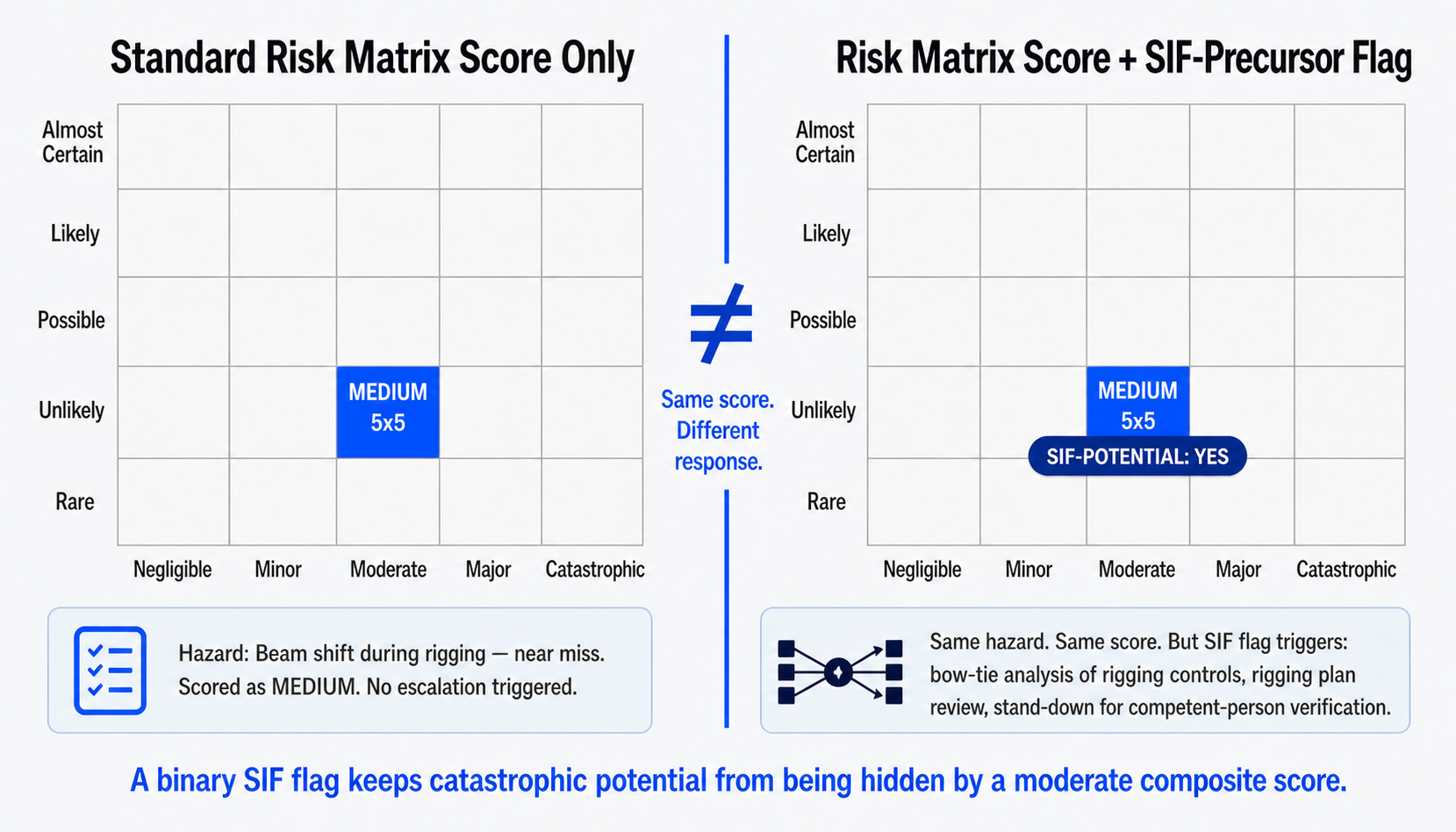
A site with a low recordable incident rate can still carry significant SIF exposure. A standard risk matrix will not show that clearly because it blends frequent, lower-severity injuries with low-frequency catastrophic exposures in the same scoring system. Recordable rates describe injury frequency. SIF flags show catastrophic potential. Those are different issues and need different data streams.
SIF exposures are events or conditions that, under slightly different circumstances, could result in a fatality or life-altering injury. These should be flagged separately in the risk register, even when the basic likelihood and severity score looks moderate.
- Rather than creating a separate matrix, this approach adds a binary SIF flag to each hazard in the register.
- A hazard scored as medium but flagged for SIF potential requires different controls and leadership attention than a medium-risk hazard with low-severity potential.
That flag should trigger a different response: a bow-tie analysis of the critical controls around the hazard, a review of the work plan, and a stand-down to verify oversight. If the reporting system creates friction, paper forms, English-only apps, or a trip to the trailer, critical near-miss reports may never reach the register. Reducing that friction, for example by switching from paper forms to construction safety management software, makes it more likely those reports are captured in time to matter.
Handling Overlapping Trades on Multi-Contractor Sites
The highest-risk moments on a multi-contractor jobsite often happen when two or more trades occupy the same space during a scope-of-work overlap window and neither crew’s hazard analysis accounts for the other’s presence. Managing trade stacking on multi-contractor sites requires active information sharing between trades, beyond basic scheduling coordination.
Your site-level risk assessment must map these overlap windows explicitly.
Let’s walk through a potential scenario where trade stacking can cause issues. Ironworkers completed overhead connections while mechanical contractors staged ductwork on the floor directly below during the transition from structural work to mechanical, electrical, and plumbing rough-in on a data-center project. Their JHA addressed fall protection and rigging. Meanwhile, the mechanical crew’s JHA addressed manual handling and material storage. Neither addressed the struck-by exposure created by their simultaneous presence.
That struck-by exposure belongs in the register as its own line item, and the permit-to-work system should require both crews to acknowledge the shared-space controls before work begins. To do this, structured input is needed from every subcontractor. Before each phase transition, require each subcontractor to submit its planned high-risk activities and the areas it will occupy. Map these against each other to identify conflicts. The findings should feed the risk register and the daily PTP process for all affected crews.
How to Tell If Your Field Observation Data Is Real or Quota-Driven
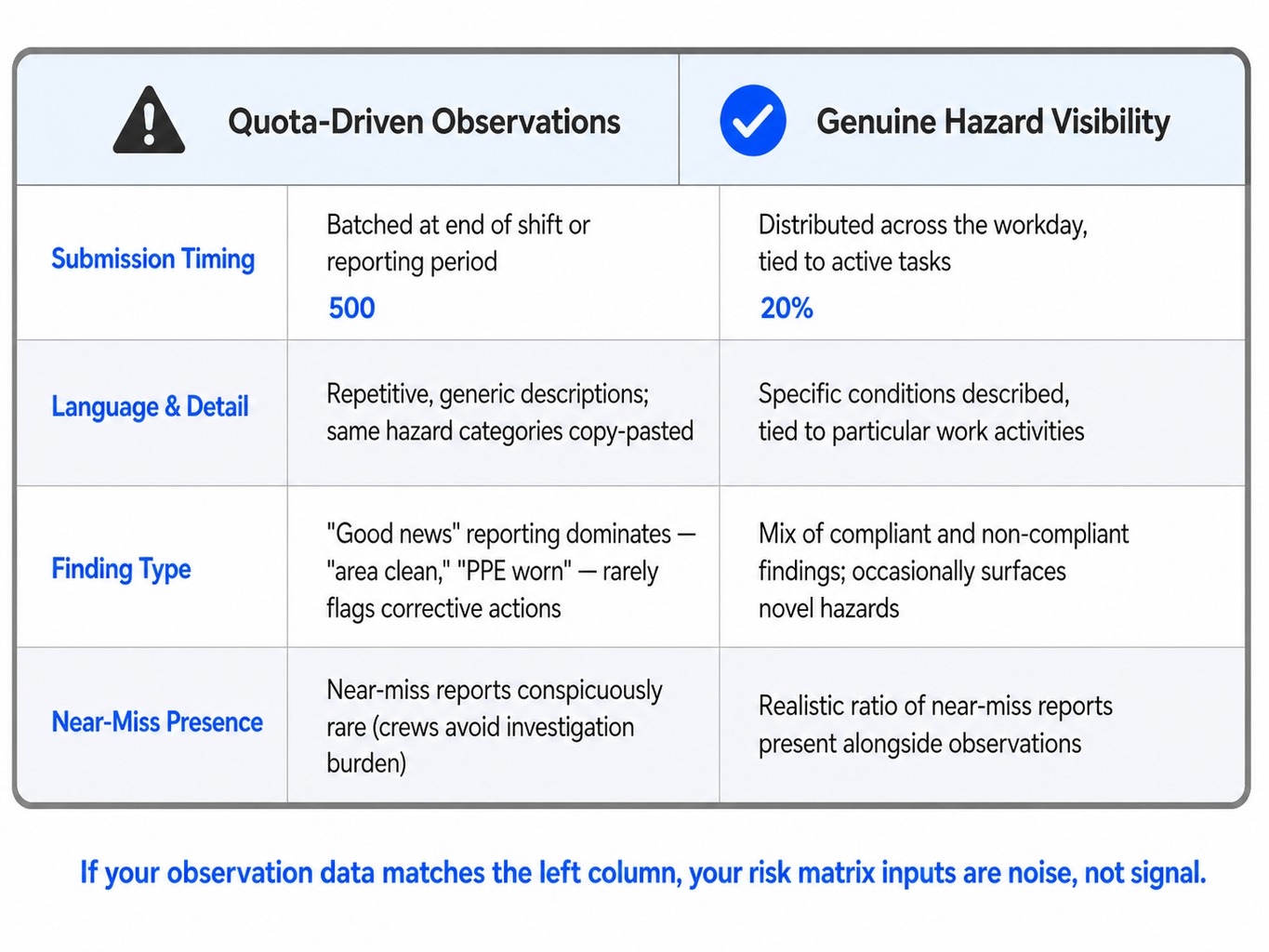
Many organizations measure safety engagement by observation volume. That metric can be useful, but high volume does not equal good hazard visibility if the observations are quota-driven. If the observation data feeding hazard identification is built on noise, the risk matrix will reflect it.
Quota-driven observation programs produce a recognizable data signature. Common signs include:
- Submission clustering: Observations are submitted in batches at the end of the shift or reporting period as crews rush to hit their number.
- Repetitive language: The same hazard categories appear repeatedly with identical, generic descriptions.
- Good-news reporting: Observations rarely identify conditions that require corrective action. They mostly describe compliant behavior, such as area clean or personal protective equipment worn, to fill the quota.
- Absence of near misses: Near-miss reports are conspicuously rare because they require investigation, which crews often avoid when the goal is simply to hit a number.
Genuine hazard visibility looks different. Observations are distributed across the day, describe specific conditions tied to active work, occasionally surface novel hazards, and appear alongside a realistic ratio of near-miss reports. Before trusting the data, review a sample qualitatively. Read a set of entries and determine whether they describe something a crew member actually saw and judged worth reporting, or whether they read like a compliance exercise.
Reviewing the Assessment: Learning Teams, Near-Miss Feedback, and Portfolio Carryover
A risk assessment needs regular review as the project evolves. Learning teams after incidents and near misses often produce the most useful updates. Scheduled quarterly reviews still matter, but they rarely surface the same level of detail on their own.
After a near-miss, assemble a cross-functional learning team that includes crew members from the affected and adjacent trades. The team should determine what happened, which controls failed or were absent, and what the assessment should have anticipated. The learning team should update the risk register directly, revising how that hazard is scored, controlled, or flagged for serious injury and fatality potential going forward. Understanding how to set up and follow a corrective action plan helps make sure those revisions translate into accountable follow-through.
Those findings need to move beyond the immediate crew and incident.
Across subcontractors: A learning-team finding should be shared with every subcontractor on site exposed to the same hazard, not siloed within the trade that experienced the event.
Across the portfolio: If an organization operates multiple projects, findings from one site’s learning team should feed into the risk assessments of similar projects. A struck-by near-miss involving a floor opening on one data-center build should update the risk register template for the next comparable project. The same lesson should not need to be learned twice.
Handled this way, the review step is where the risk assessment earns its value.
Read more: Learning From Past Incidents Toolbox Talk
Using Safety Mojo to Feed Frontline Data into Your Risk Assessment
Every step above depends on frontline data reaching the assessment. Many organizations struggle because the systems meant to capture that data, paper forms, English-only apps, and trailer-based reporting, create too much friction for crews to use consistently. The result is a risk matrix built on assumptions instead of current field conditions.
Safety Mojo’s tools are built to reduce that friction for crews.
- Flex PTP captures crew-level task hazards before each shift and checks daily plans against the work that was identified during planning. That gives safety leaders a clearer link between the site-level assessment and what crews are actually preparing to do each day.
- Risk Feed surfaces high-risk items from daily submissions so frontline leaders can quickly see where attention is needed. That helps crews and supervisors spot elevated risk in time to fix the problem before an accident happens.
- My Day Dashboard gives supervisors a daily view of the work, the crews involved, and the risks tied to that day’s plan. That supports better field coordination and helps keep the plan visible at the point of execution.
Together, these tools help teams connect planning, daily preparation, and frontline visibility without adding more paperwork to the job.
See how Flex PTP, My Day Dashboard, and Risk Feed connect crew-level hazard data to your risk assessment, and request a walkthrough.
Frequently Asked Questions
1. Who is qualified to conduct a construction site risk assessment?
The assessment should be led by competent safety personnel with direct knowledge of the site’s work activities and regulatory requirements. Competence combines practical field experience with formal safety training. The assessment team should also include superintendents and trade foremen who understand the actual work sequences, so the process stays grounded in operational reality rather than paperwork alone.
2. How often should a construction site risk assessment be reviewed and updated?
Formal reviews should occur at every major phase transition, after any recordable incident or high-potential near miss, and whenever a new subcontractor mobilizes or a significant scope change occurs. Between those formal reviews, the risk register should update continuously as field observations, PTP flags, and near-miss reports surface new hazards. A quarterly review may satisfy an internal schedule, but event-driven updates are usually more valuable.
3. How do pre-task plans connect to the overall project risk assessment?
The site-level risk assessment identifies which hazard categories and critical controls apply to each work phase. The daily pre-task plan translates those controls into crew-specific actions and verifies that they are in place before work begins. PTP data also feeds back upward. If crews consistently flag a hazard that the site assessment missed or scored too low, the register should be updated.
4. What risk matrix standards apply to building construction activities?
Key frameworks include ISO 45001:2018 for the overall safety management system, ANSI/ASSP Z590.3 for risk assessment methodology, and EN 31010 for specific risk management techniques. No single standard prescribes one universal matrix format. Organizations should select a likelihood and severity scale, often 5×5, that matches their risk tolerance and then apply it consistently. The format matters less than honest scoring informed by real field data.
5. How do you prevent low-frequency high-severity risks from being underscored in a risk matrix?
The most effective method is to add a binary serious injury and fatality potential flag to each hazard, separate from the likelihood-times-severity score. That ensures a hazard with low probability but fatal potential receives escalated controls and leadership attention regardless of its composite score. Without that flag, catastrophic hazards can settle into the same priority tier as frequent but minor injuries over time.


